
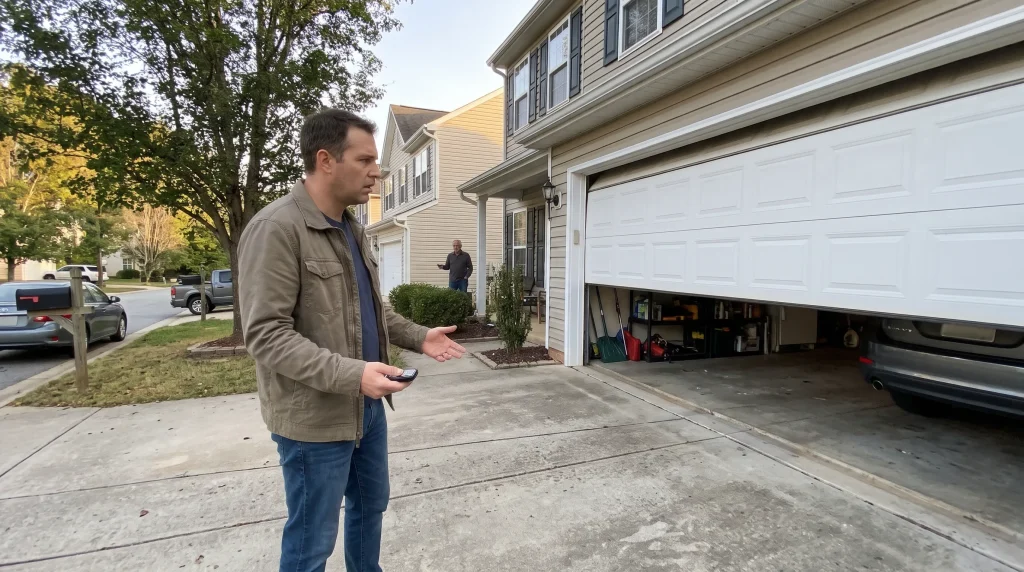
Garage doors most commonly open by themselves because of a stuck remote button, radio frequency interference, a failing circuit board, or a faulty wall switch sending a false signal. Less often, the cause is a neighbor’s remote on the same frequency, a wiring short, a worn relay switch, or temperature swings affecting the opener’s electronics. Most of these are simple garage door repair checks you can run in a few minutes; a few point to a genuine safety issue worth calling a professional for.
Key Takeaways
- A garage door opening with no one home is almost always electrical or radio-based, not mechanical.
- Removing the batteries from every remote in the house is the fastest way to rule out a stuck button.
- Interference from other 300-400MHz devices can trigger the same symptom as a hardware fault.
- A door that opens itself is a security risk, so treat it as urgent even if it seems minor.
- Circuit board failures often show other symptoms too, like flickering motor-unit lights or inconsistent remote response.
- If unplugging the opener stops the problem, the fault is almost certainly inside the opener unit.
DIY-Safe Checks vs. When to Call a Pro
|
Situation |
DIY-Safe to Check |
Call a Pro |
|
Stuck remote button |
Yes, remove batteries and test |
If it recurs after replacing batteries |
|
Interference from nearby devices |
Yes, temporarily unplug or move devices |
If interference persists after isolating them |
|
Wall switch acting up |
Yes, disconnect and test opener without it |
If disconnecting doesn’t stop the issue |
|
Suspected circuit board failure |
No |
Yes, always |
|
Wiring short or burning smell |
No |
Yes, immediately |
|
Worn relay switch |
No |
Yes |
1. A Stuck or Damaged Remote Button
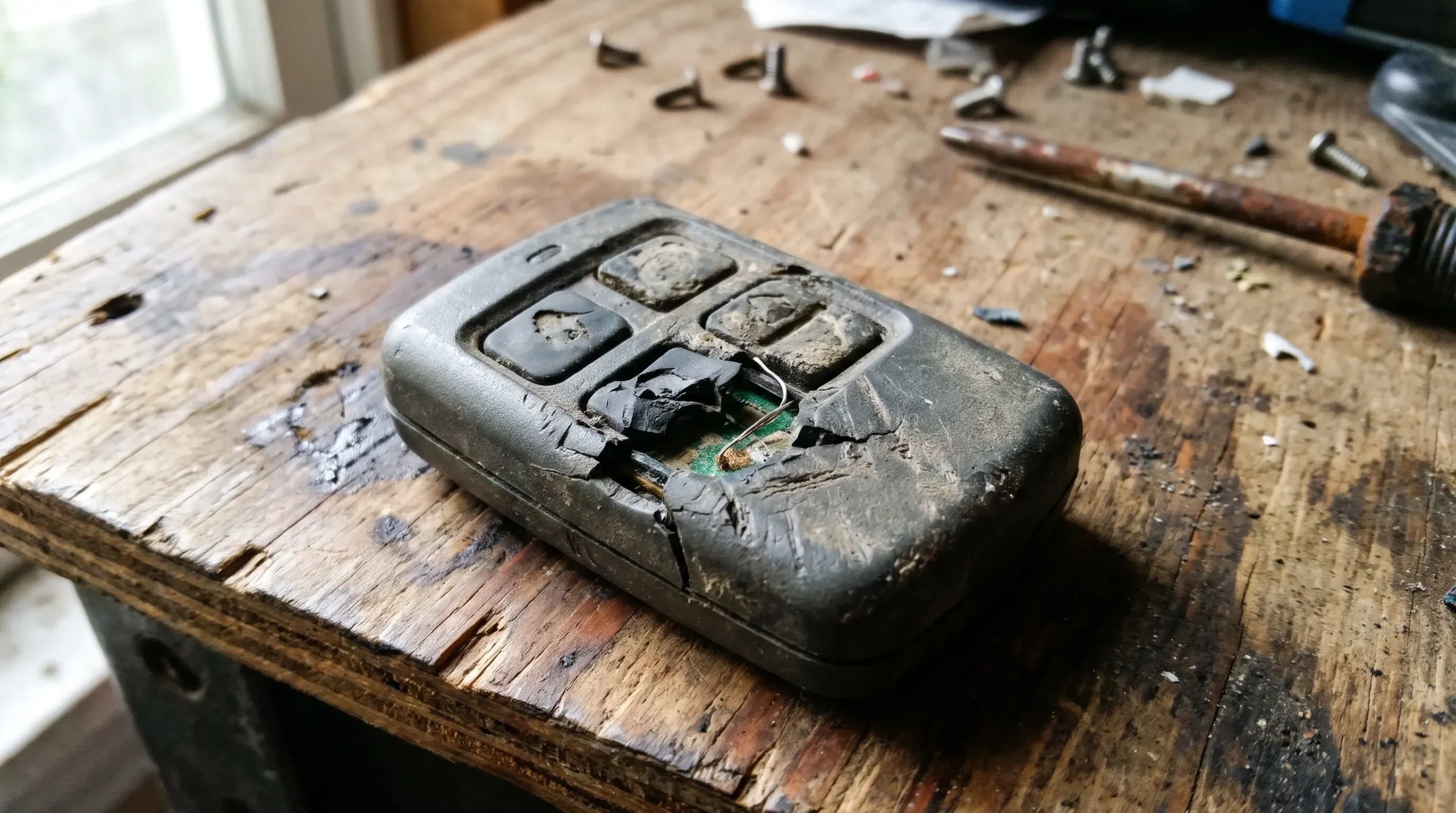
Symptom: The door opens intermittently, especially when a remote has been sitting in a pocket, bag, or hot car.
Most likely cause: The internal button switch is stuck in the pressed position, sending a continuous open signal.
Fix steps:
- Remove the batteries from every remote in the house, one at a time, and watch whether the opening stops
- Inspect each remote for a button that doesn’t spring back on its own, and replace any remote that feels sticky or physically depressed
Call a pro if: removing batteries from every remote in the house doesn’t stop the problem.
How to Test Which Remote Is Causing Your Garage Door to Open Itself
Pull the batteries from one remote at a time over the course of a day. Whichever removal stops the phantom opening is the one with the stuck button.
A closer look: A remote that’s spent months riding in a glove box or a tight backpack pocket is a prime candidate, since constant low-level pressure on the button causes this over time. Checking what that remote was doing on the days it happened often confirms the pattern.
For the full breakdown of the signs a stuck button leaves behind, see Why Does My Garage Door Opener Keep Sending a Signal? 4 Signs of a Stuck Remote Button.
2. Radio Frequency Interference From Nearby Devices
Symptom: The opening seems random, but sometimes lines up with when a specific device in the house turns on.
Most likely cause: A newer baby monitor, wireless camera, or router sharing a frequency close to your opener’s, especially on older 300-400MHz systems.
Fix steps: Temporarily unplug or relocate any newly added wireless devices, one at a time, and note whether the opening stops.
Call a pro if: the issue persists after isolating every nearby device. A frequency-hopping remote and receiver upgrade may be the only real fix.
Which Household Devices Commonly Interfere With a Garage Door Opener
Baby monitors, wireless security cameras, and some smart home hubs are the most frequent culprits, since many share the same unlicensed radio bands older garage door openers use.
A closer look: The timing usually gives it away faster than any technical test. If the phantom opening started within days of a new device showing up in the house, that’s a much stronger clue than any symptom of the opener itself. Older, fixed-frequency openers made before the widespread shift to rolling-code technology are especially prone to this, since they weren’t designed to filter out signals sharing a similar frequency.
3. A Failing Circuit Board (Logic Board)
Symptom: The door opens with no remote nearby, often paired with flickering lights on the motor unit or a remote that responds inconsistently.
Most likely cause: Aging capacitors or moisture damage on the logic board are sending a false open signal without any input at all.
Fix steps: There’s no safe DIY fix here beyond confirming the pattern. Note when it happens and whether other symptoms (flickering lights, slow response) show up alongside it.
Call a pro if: this pattern matches. A circuit board issue almost always needs a technician, and on an older unit, a full garage door opener replacement is often more practical than sourcing a board.
Signs a Garage Door Opener’s Circuit Board Is Failing, Not Just the Remote
A failing board rarely acts alone. Flickering motor-unit lights, a delayed response, and phantom operation with every remote removed all point to the board rather than a single stuck button.
A closer look: Openers past the ten-year mark, or that went through a storm without a surge protector, are the ones we see this in most often. The failure tends to build over weeks, with small glitches showing up before the phantom opening becomes regular.
For the full set of warning signs, see How Do You Know If Your Garage Door Opener’s Circuit Board Is Failing? 5 Warning Signs.
4. A Faulty Wall-Mounted Control Switch
Symptom: The door opens itself even with every remote’s batteries removed, especially with an older wall switch that has worn buttons.
Most likely cause: An internal short in the wall switch or its wiring is sending a continuous signal to the opener’s terminals.
Fix steps: Disconnect the wall switch wires from the opener’s control terminals and see if the phantom opening stops.
Call a pro if: disconnecting the switch doesn’t resolve it, or you’re not comfortable working at the opener’s terminals.
Because a faulty wall switch can also interfere with the opener’s built-in safety reversal, DASMA’s safety tips for homeowners recommend testing the auto-reverse feature every month, regardless of what’s ultimately causing the phantom opening.
For the full set of signs a bad switch leaves behind, see Can a Faulty Wall Switch Make Your Garage Door Open By Itself? 5 Signs to Check.
5. A Neighbor’s Remote on the Same Frequency
Symptom: The opening happens at times that don’t correlate with anyone in your household, occasionally right around when a neighbor arrives home.
Most likely cause: Older fixed-code openers, generally those made before the widespread adoption of rolling-code technology, share a small set of frequencies, and two units nearby can occasionally cross signals.
Fix steps: Check your opener’s model and manufacture date. If it’s a rolling-code model, reprogramming the remote’s code can resolve an accidental cross-signal.
Call a pro if: reprogramming doesn’t help, or your opener predates rolling-code technology, since that usually points to a full replacement rather than a quick fix.
6. Electrical Short or Wiring Fault
Symptom: The opening is paired with other odd electrical behavior:
- Flickering garage lights
- A tripped breaker
- A faint smell of burning plastic
Most likely cause: Damaged wire insulation lets two wires touch and send a false open signal to the motor unit.
Fix steps: None that are safe to attempt yourself. Damaged wiring carries a real risk of shock or fire.
Call a pro if: this is even a possibility. Unplug the opener immediately if you notice any burning smell, and don’t wait to book a repair.
For a broader look at how wiring issues show up across different garage door symptoms, The Spruce’s guide to troubleshooting common garage door problems covers several related electrical faults worth ruling out.
7. A Worn or Sticking Relay Switch
Symptom: The opener runs briefly on its own with nothing triggering it, sometimes with a faint clicking sound from the motor unit right before it happens.
Most likely cause: The internal relay that controls motor direction sticks closed instead of releasing after each use.
Fix steps: None that are safe to attempt yourself, since the relay is inside the sealed motor housing.
Call a pro if: this pattern matches. A stuck relay is a hardware failure, not a settings issue.
8. Temperature-Related Circuit Board Glitches
Symptom: The phantom opening happens more often during extreme heat or cold, especially in an uninsulated garage.
Most likely cause: Temperature swings cause solder joints or capacitors on the logic board to expand and contract, occasionally creating a brief short.
Fix steps: Track whether the issue only shows up above or below a certain temperature, and note the pattern to share with a technician.
Call a pro if: the pattern is clearly temperature-linked. This usually points to a board that needs replacing regardless of the season. A seasonal garage door tune-up can also catch age-related electronics issues like this before they lead to a full failure.
Quick Diagnostic Checklist
- Remove the batteries from every remote in the house and watch for 24 hours
- Note the exact time of day each phantom opening happens
- Check whether unplugging the opener itself stops the problem entirely
- Watch for flickering lights, clicking sounds, or a burning smell from the motor unit
- Disconnect the wall switch and run the opener without it to see if the issue stops
Don’t Ignore a Door That Opens Itself
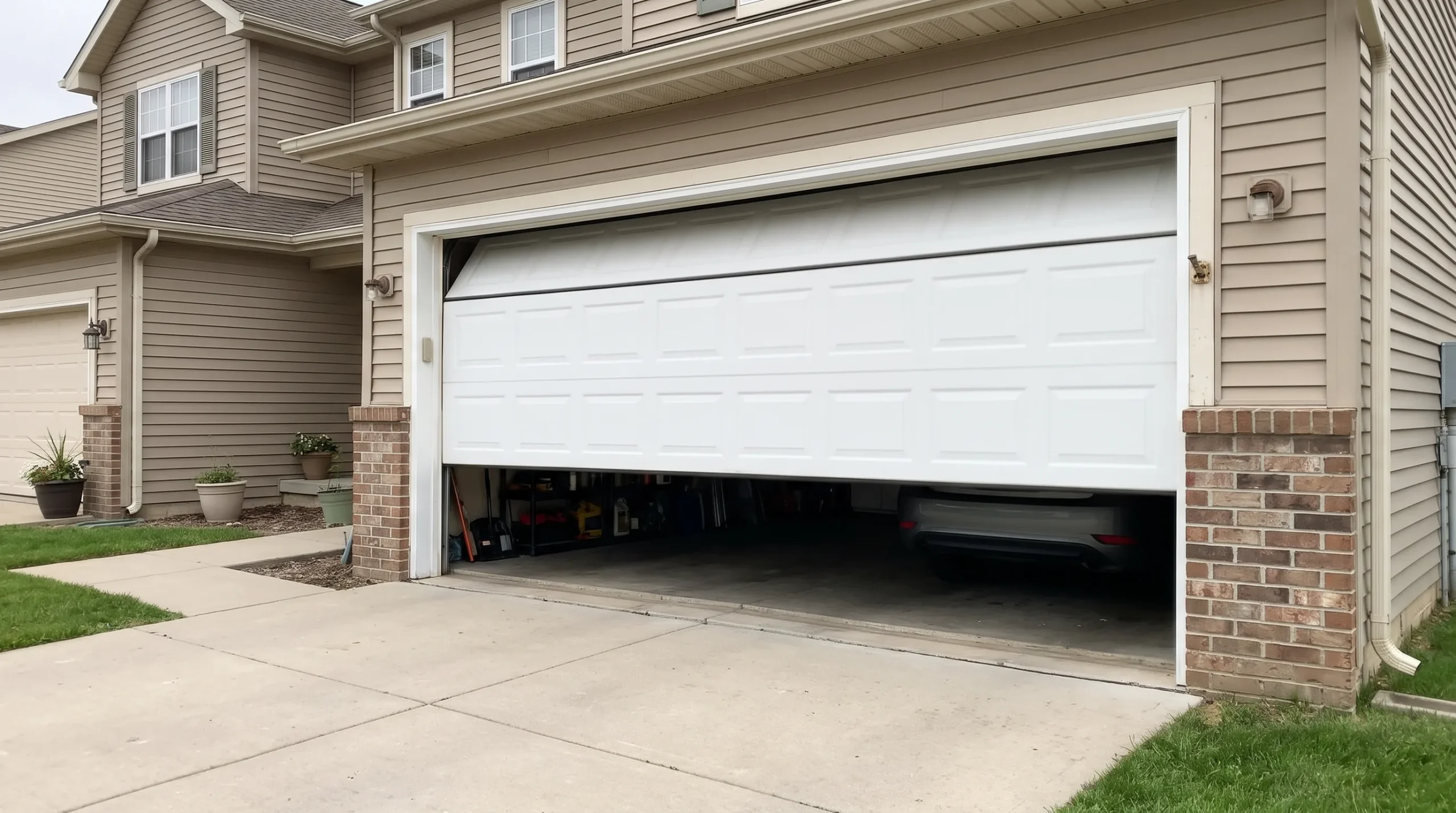
A garage door that opens on its own is more than an inconvenience. It’s an open invitation for anyone walking by, and it usually means something inside the opener needs attention rather than the door itself.
DoorJam Garage sees this exact issue several times a year, almost always traced back to the remote, the circuit board, or interference from a newer device nearby. If your garage door keeps opening on its own after working through the checks above, contact us or give us a call.