
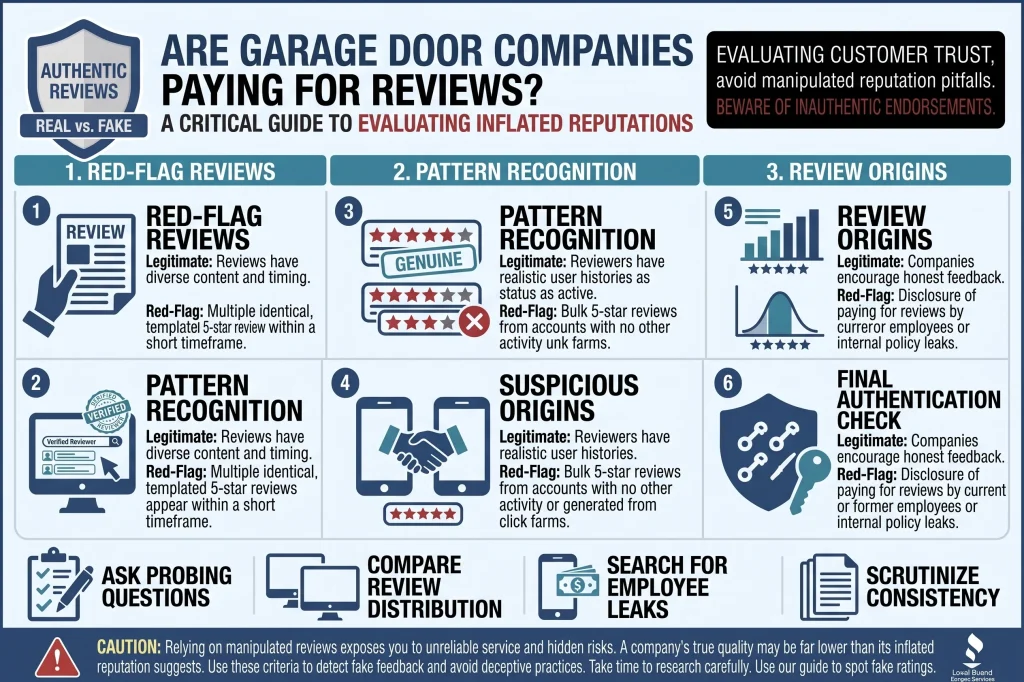
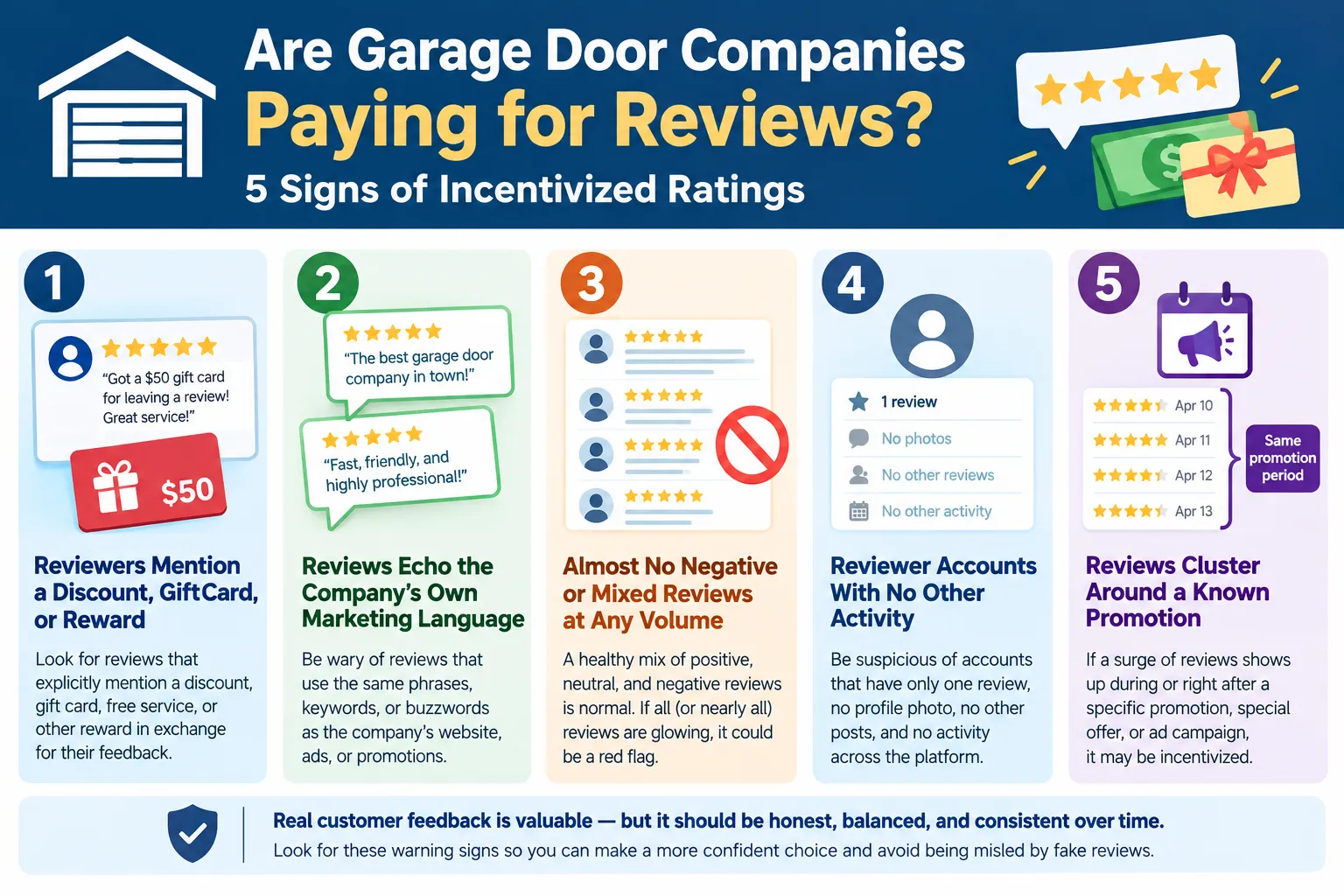
Yes, some garage door companies do pay for reviews, usually through gift cards, discounts, or free garage door repair calls offered in exchange for a five-star post, and most major review platforms and the FTC prohibit this when undisclosed. The five clearest signs are: reviewers mentioning a discount or reward, repeated phrasing matching the company’s own marketing copy, an unusually high ratio of five-star reviews with almost no criticism, reviewer profiles with no other activity, and reviews clustered around a specific promotion.
Key Takeaways
- Disclosed incentives (a review in exchange for a discount, clearly stated) are legal in most cases; undisclosed paid reviews that pretend to be organic are not.
- Reviews that echo a company’s own website language almost word for word often trace back to a script provided to reviewers.
- A near-total absence of negative or mixed reviews, especially at high volume, is a stronger signal than any single suspicious review.
- Reviewer accounts created only to post one glowing review, then never used again, are a common thread in incentivized review campaigns.
- Reviews clustered tightly around a known promotion period (a giveaway, a discount code) are worth extra scrutiny.
Disclosed Incentives vs. Undisclosed Paid Reviews
Factor | Disclosed Incentive | Undisclosed Paid Review |
Transparency | Reviewer states the discount or reward | No mention of any compensation |
Legality | Generally allowed if platform permits and disclosed | Violates FTC guidance and most platform policies |
Review detail | Often still specific about the job | Usually vague, generic praise |
Rating pattern | Mixed with normal negative/positive spread | Overwhelmingly five-star with no criticism |
Reviewer history | Normal review activity elsewhere | Single-use or empty account |
1. Reviewers Mention a Discount, Gift Card, or Reward
What it looks like: A review that includes a line like “got $20 off for leaving this review” or “they gave me a gift card.”
Why it happens: Some companies offer an incentive to boost review volume quickly, and a portion of reviewers disclose it, sometimes required by the platform’s terms, sometimes out of honesty.
How to check it: Read through recent reviews for any mention of a discount, coupon, gift card, or “thank you” tied to the review.
Trust it if: the incentive is disclosed and the review still includes real, specific detail about the job. Disclosed incentives paired with genuine detail are a much smaller concern than undisclosed ones.
Are Garage Door Companies Legally Allowed to Offer Review Incentives?
Platforms like Google and Yelp generally prohibit incentivized reviews regardless of disclosure, and the FTC requires any material connection between a business and a reviewer to be clearly disclosed. A company that fails to disclose a review-for-discount arrangement is violating both platform policy and federal guidance.
A closer look: A review that reads “Got a $25 gift card for leaving this, but honestly the technician did great work fixing our spring” is disclosing an incentive while still giving a useful, specific account. Compare that to a review that simply says “great service” with no detail and no mention of any incentive at all, even though the company runs a known review-for-discount program. The second scenario is the one worth flagging, since the incentive exists but isn’t disclosed and the review offers nothing to verify against.
If you want the full checklist for evaluating a company’s reviews beyond just incentives, read How to Tell If the Garage Door Company Reviews Are Fake.
2. Reviews Echo the Company’s Own Marketing Language
What it looks like: Multiple reviews use the exact phrases found on the company’s website or ads: “family-owned since 1998,” “same-day service guarantee,” or a specific tagline.
Why it happens: Some incentivized-review scripts are built directly from a company’s own marketing copy, since it’s an easy template to hand reviewers.
How to check it: Compare a few reviews against the company’s homepage or ad copy. Repeated taglines or slogans showing up verbatim in “customer” reviews is a red flag.
Trust it if: reviews use everyday, personal language rather than brand phrasing.
A closer look: If a company’s homepage says “your trusted, family-owned garage door experts since 2010,” and five different “customers” independently use that exact phrase, or a close variation of it, in their reviews, that’s not a coincidence. Real customers don’t usually memorize a business’s tagline word for word before writing a review. When a review reads like it was lifted straight from an About page, treat it as a strong sign the review wasn’t written from a genuine, independent experience.
If the language across a review page just sounds generic rather than lifted from marketing copy, read Why Do Fake Garage Door Company Reviews Sound So Generic? 6 Phrases That Give It Away.
3. Almost No Negative or Mixed Reviews at Any Volume
What it looks like: A company with 100+ reviews and a 4.9 or 5.0 average, with no visible 1, 2, or 3-star reviews.
Why it happens: A company running an incentive program often only rewards happy customers for reviewing, or filters unhappy customers to a private feedback channel, which skews the public rating.
How to check it: Filter by star rating on the review platform. If nothing shows up below 4 stars at high review volume, treat the rating with caution.
Trust it if: there’s a normal spread including some 3 and 4-star reviews mixed in with the positive ones.
5 Signs of Incentivized Ratings, at a Glance
- Disclosed or undisclosed discounts mentioned in reviews
- Marketing language repeated verbatim
- An unnaturally high percentage of five-star reviews
- Reviewer accounts with no other history
- Reviews clustered around a known promotion period
The International Door Association’s Scam Awareness resources for homeowners list similar red flags for the garage door industry as a whole, and the association’s LinkedIn post on garage door industry scam awareness echoes the same concerns homeowners raise nationwide.
A closer look: A company with 340 reviews and a 4.9 average sounds impressive until you filter by star rating and find exactly zero reviews below 4 stars, not even a single 3-star review noting a scheduling delay or a minor miscommunication. Real service businesses, even excellent ones, accumulate a handful of average or mixed reviews over hundreds of jobs simply because customers have different expectations and experiences. A page with none at all, at that volume, is a statistical outlier worth noticing.
4. Reviewer Accounts With No Other Activity
What it looks like: The account posting the review has no profile photo, no other reviews, and appears to exist for this one post.
Why it happens: Incentivized-review campaigns sometimes recruit reviewers through gig platforms, and those reviewers rarely use the same account again.
How to check it: Click into several reviewer profiles. A pattern of single-use accounts across multiple reviews on the same business page is a meaningful signal.
Trust it if: most reviewer accounts show a normal history of reviewing other, unrelated local businesses.
A closer look: Incentivized-review recruitment sometimes happens through gig platforms where reviewers are paid a small fee per post across many unrelated businesses, not just garage door companies. If you click into a reviewer profile and see that their only other reviews are for a mattress company, a moving service, and a solar installer, all posted within the same few weeks, that pattern points toward a paid reviewer working through a list of clients rather than an actual local homeowner.
5. Reviews Cluster Around a Known Promotion
What it looks like: A wave of reviews appears right around the dates of a specific social media giveaway, a “leave a review, get 10% off” campaign, or a similar promotion the company ran publicly.
Why it happens: Even disclosed incentive programs, if run at scale, can create an artificial spike that doesn’t reflect the company’s typical service volume or satisfaction rate.
How to check it: If you can find the promotion’s dates (often on the company’s social media), compare them against the review timeline.
Trust it if: the promotion was transparent, and the resulting reviews still include specific, honest, varied feedback rather than uniform praise.
A closer look: A company running a public, disclosed “leave a review, get 10% off your next service” campaign for two weeks and picking up 15 reviews during that window isn’t necessarily doing anything wrong, especially if the reviews still describe real jobs. The concern arises when that same volume of reviews shows up with no visible promotion anywhere, or when the promotion itself has vanished from the company’s social media by the time you go looking for it. Transparency about the incentive, even a large one, is a meaningfully different situation than reviews that appear to have no origin story at all.
If that volume of reviews also appeared within days rather than tied to a known promotion, read Why Do Garage Door Companies Get Sudden Bursts of 5-Star Reviews? 4 Red Flags to Watch.
Incentive Red Flag Checklist
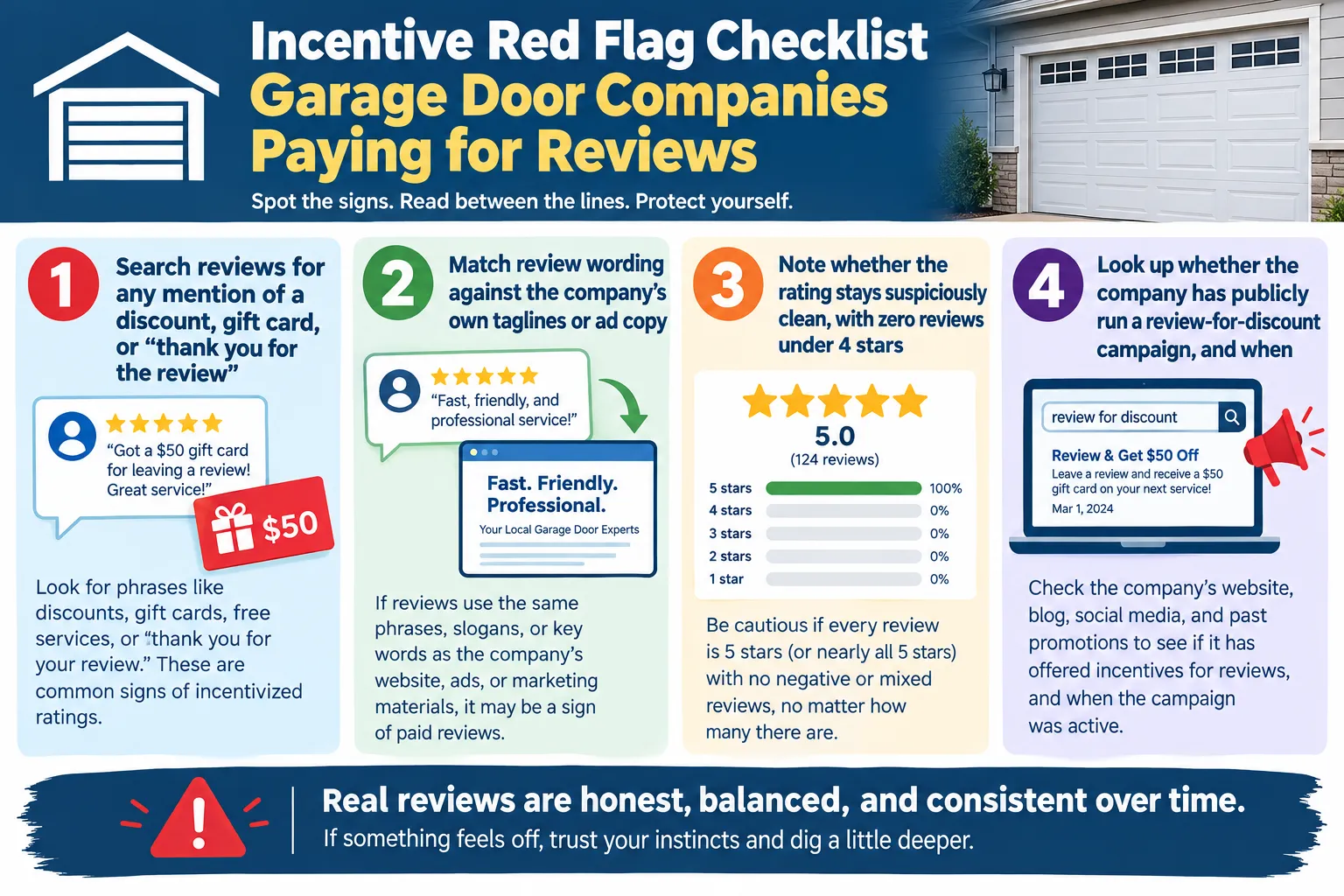
- Search reviews for any mention of a discount, gift card, or “thank you for the review”
- Match review wording against the company’s own taglines or ad copy
- Note whether the rating stays suspiciously clean, with zero reviews under 4 stars
- Look up whether the company has publicly run a review-for-discount campaign, and when
Ask Before You Assume
Some incentivized reviews are disclosed and harmless; others manufacture a rating that doesn’t reflect real service quality. Checking for disclosed incentives, repeated marketing phrasing, and an unusually clean rating spread will catch most of it.
DoorJam Garage hears this question often from homeowners comparing quotes who notice a review mentioning a discount or a suspiciously clean rating. If you’d like a straight answer about how we earn our reviews, contact us today or give us a call.