
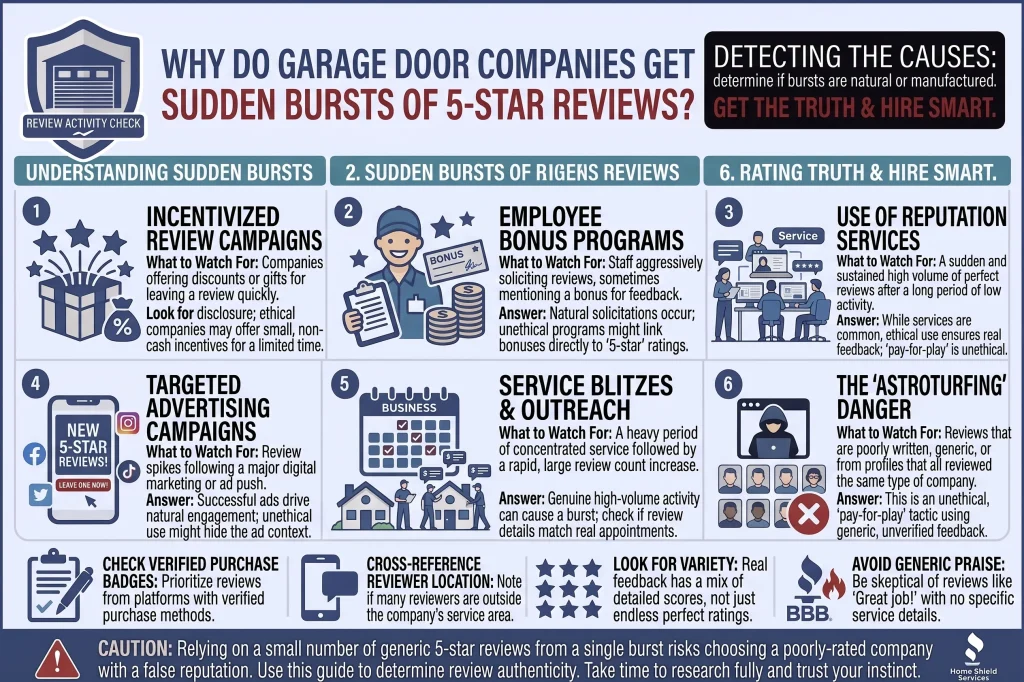
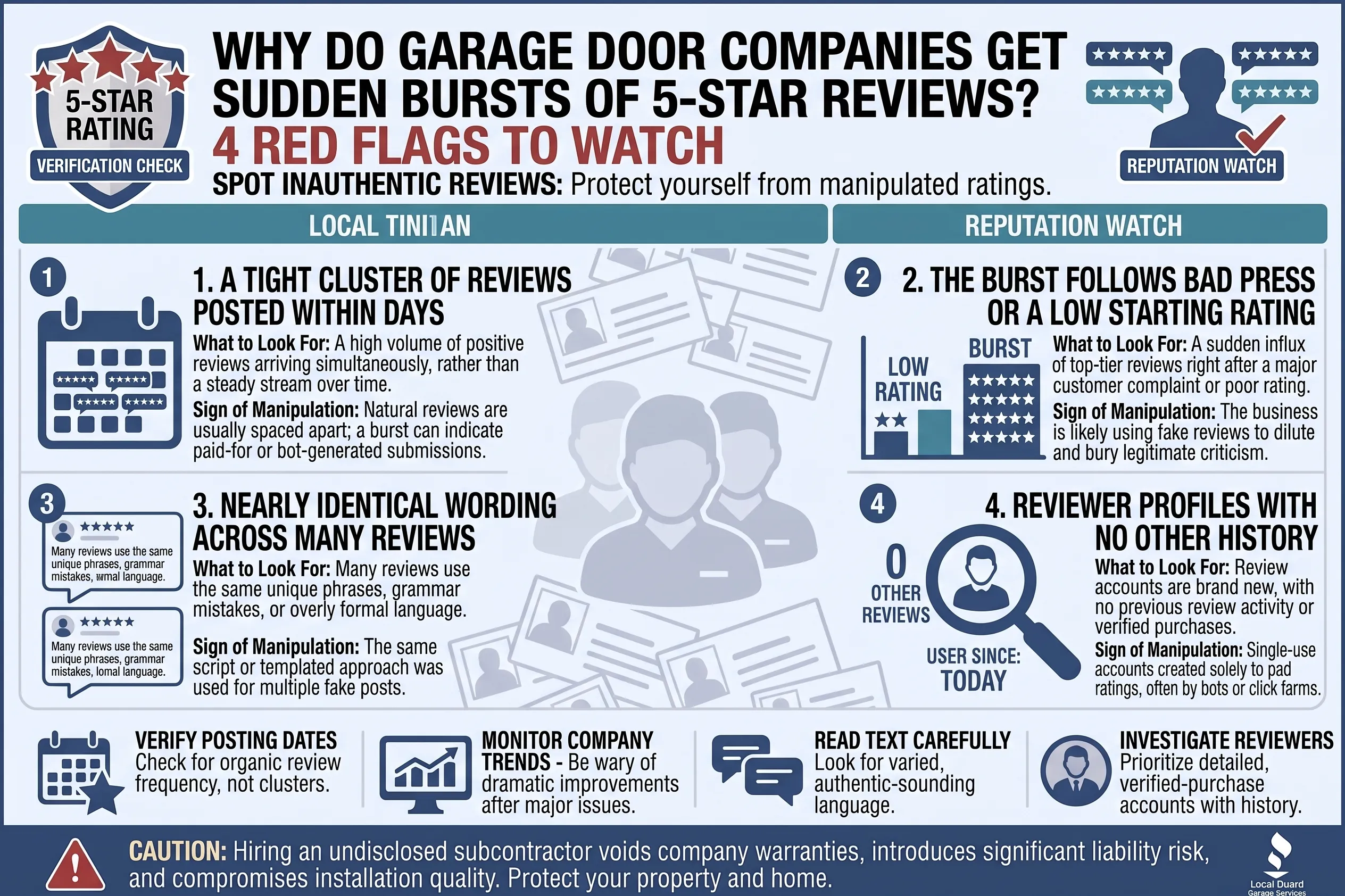
A sudden burst of five-star reviews, usually 10 or more posted within a few days, almost always signals a paid review campaign rather than a genuine spike in happy customers. The four clearest red flags are: a tight posting window with little review activity before or after, near-identical wording across the new reviews, reviewer profiles with no other history, and a burst that lines up suspiciously with a period of bad press or a low starting rating.
Spotting one of these is worth a second look; spotting two or more is a strong signal to verify the company another way before booking. None of these checks require special tools or industry knowledge; they’re the kind of thing any homeowner can run through in a few minutes on their phone before ever calling a company for garage door repair.
Key Takeaways
- Real review growth is gradual and tracks job volume. A company doing 5 jobs a week doesn’t suddenly generate 40 reviews in 3 days.
- Bursts that follow a bad review, a news story, or a rebrand are often a direct response, an attempt to bury the negative signal with volume.
- Nearly identical phrasing across a burst of reviews points to a script, not independent customers writing in their own words.
- New or single-review reviewer accounts posted in the same short window are a hallmark of purchased review batches.
- Checking the posting dates takes 30 seconds and catches this pattern faster than reading the review text.
- None of these signs alone proves a rating was manipulated, but two or more appearing together is a much stronger case than any single red flag.
Real Review Growth vs. a Bought Review Burst
Signal | Organic Growth | Bought Burst |
Timing | Spread across months or years | Concentrated in days |
Volume jump | Small, steady increases | Large jump (10+) in a short window |
Wording | Varied, personal | Repeated or near-identical |
Reviewer history | Reviews multiple local businesses | Single review, new account |
Context | No unusual event preceding it | Follows bad press or a low rating |
1. A Tight Cluster of Reviews Posted Within Days
What it looks like: 15, 30, or even 100 reviews appear within a week or two, often after months of little to no new reviews.
Why it happens: Review-buying services deliver reviews in scheduled batches, since the goal is to move a rating quickly rather than build it organically.
How to check it: On Google, open the reviews, sort by “Newest,” and scroll through the dates. A steady trickle over months looks organic. A wall of same-week or same-day reviews does not.
Trust it if: the burst is small (a handful of reviews) and coincides with a real event you can verify independently, like a grand-opening promotion tied to actual completed jobs.
A closer look: Picture a company that had 22 reviews and a 4.3 average in early June, then jumped to 61 reviews and a 4.8 average by the middle of July, with nothing on their social media or website explaining a promotion, a new crew, or a surge in local jobs. That kind of mismatch between the review timeline and the company’s visible activity is exactly the pattern that should make a homeowner pause before booking. A legitimate business doing that much extra work would usually have some trace of it elsewhere: more trucks on the road, more job photos posted, more scheduling availability disappearing.
If timing is just one piece of what’s bothering you about a review page, read How to Tell If the Garage Door Company Reviews Are Fake for the full checklist.
2. The Burst Follows Bad Press or a Low Starting Rating
What it looks like: A company with a mediocre rating, or a business that just went through a negative news story or a wave of complaints, suddenly posts a large batch of five-star reviews shortly after.
Why it happens: Buying reviews is a fast way to dilute a bad rating or bury a recent negative story in search results.
How to check it: Search the company name plus “reviews” or “complaints” and check the timeline against the review burst. If the five-star wave appears right after negative coverage or a rating dip, that timing is not a coincidence.
Trust it if: there’s no negative event or rating dip preceding the burst, and the reviews are otherwise specific and varied.
How to Fix a Rating You Suspect Was Artificially Boosted After Bad Press
Look past the current star average and read the oldest reviews on the page instead of the newest. If the older, unfiltered reviews tell a very different story than the recent burst, weight the older history more heavily. This approach works because the oldest reviews on a page are the ones least likely to have been influenced by a later review-buying campaign. The International Door Association’s Scam Awareness resources for homeowners cover this same pattern of manufactured reputations across the broader garage door industry, and the association’s LinkedIn post on garage door industry scam awareness flags the same manipulation pattern homeowners run into locally.
3. Nearly Identical Wording Across Many Reviews
What it looks like: Several reviews in the burst use the same or very similar phrasing: “Fast, professional, and affordable!” repeated with only minor variation.
Why it happens: Review-farming services often work from a short script or a small set of approved phrases, since writing dozens of genuinely unique reviews is slower and more expensive.
How to check it: Copy a distinctive phrase from one review and search for it within the same review page. If it shows up more than once with only small changes, that’s a scripted pattern.
Trust it if: the phrasing is varied, includes small grammar quirks, or references different technicians, parts, or prices.
A closer look: Watch for oddly specific marketing phrases repeating across supposedly unrelated reviewers, things like “affordable and dependable” or “quick and courteous,” showing up in the same order more than once. Real customers describing the same company independently rarely land on identical sentence structure, word choice, and punctuation. If three or four reviews read like they were run through the same fill-in-the-blank template, that’s a stronger signal than any single review on its own.
If the wording feels too polished across the board rather than just repeated, read Why Do Fake Garage Door Company Reviews Sound So Generic? 6 Phrases That Give It Away.
4. Reviewer Profiles With No Other History
What it looks like: The accounts posting during the burst have no profile photo, no other reviews, or were created around the same time as the review itself.
Why it happens: Review-farming operations create disposable accounts to post paid reviews, then abandon them.
How to check it: Click into 4 or 5 of the newest reviewer profiles. A normal local resident’s account usually has reviews for restaurants, retailers, or other local services. An account with a single review, ever, for this one garage door company is a strong tell.
Trust it if: the reviewer accounts show a normal, varied review history across other types of local businesses.
A closer look: A reviewer account created the same week it posted a five-star review, with no profile photo and no other activity, is worth noting on its own. When five or six accounts in the same review burst share that exact profile, no photo, no history, same posting week, it stops looking like coincidence and starts looking like a batch. This is often the fastest of the four checks to run, since most platforms let you see a reviewer’s full history with a single click.
If you suspect the reviews were bought outright rather than just timed suspiciously, read Are Garage Door Companies Paying for Reviews? 5 Signs of Incentivized Ratings.
Burst-Timing Red Flag Checklist
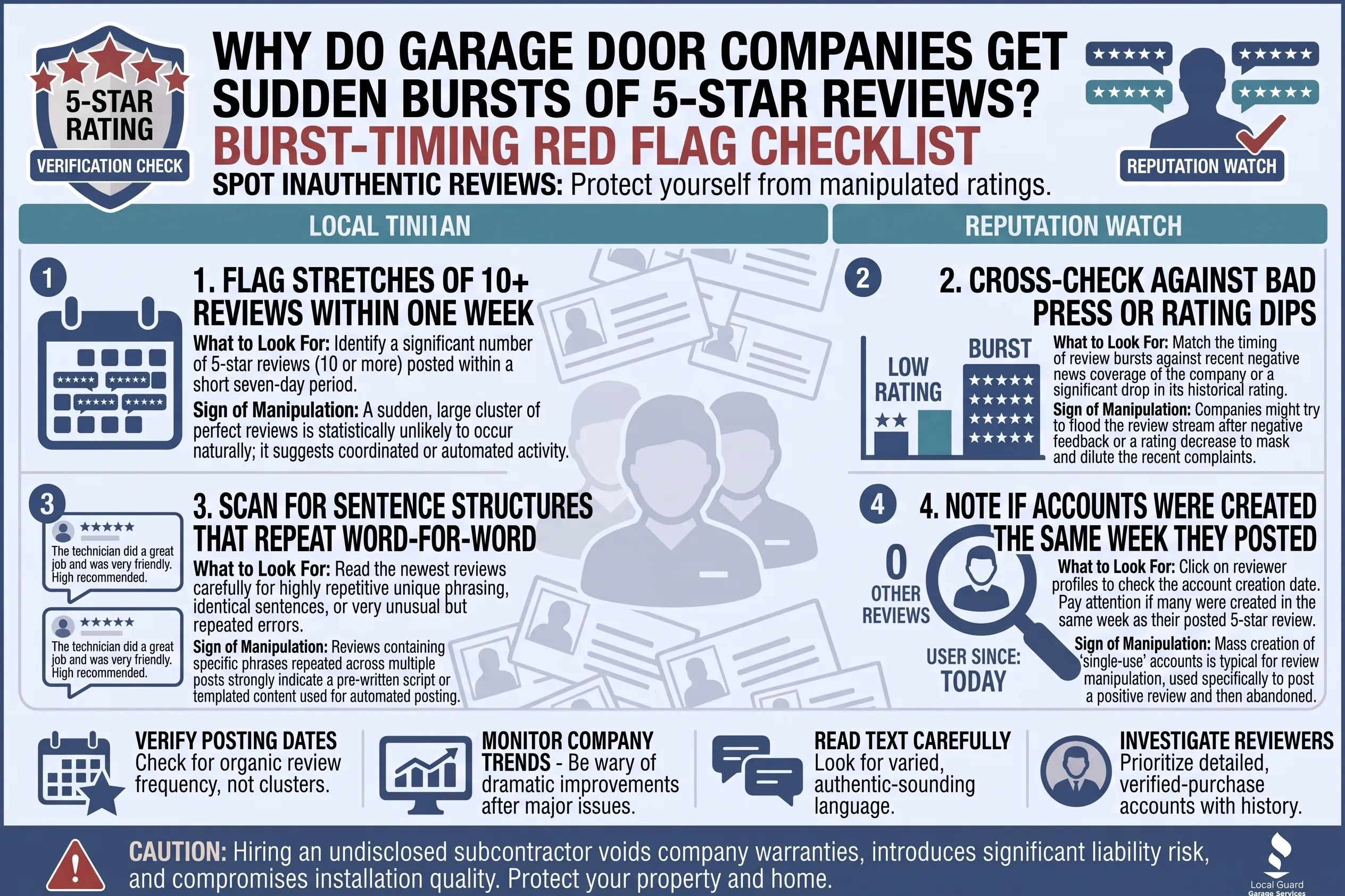
- Flag any stretch where 10 or more five-star reviews land within the same week
- Cross-check that timing against recent news coverage or a dip in the company’s rating
- Scan the newest reviews for sentence structures that repeat almost word for word
- Note whether the accounts behind the burst were created the same week they posted
What This Means for Your Next Hire
A sudden wave of five-star reviews is one of the fastest tells that a rating has been manipulated, and it takes under a minute to check by sorting reviews by date. None of the four red flags above prove fraud alone, but two or more pointing the same direction is a strong enough signal to slow down before you book.
DoorJam Garage runs into this same pattern whenever a homeowner in Wake Forest asks us to weigh in on a competitor’s sudden wave of five-star reviews. If you’d rather skip the guesswork, contact us today or give us a call.