
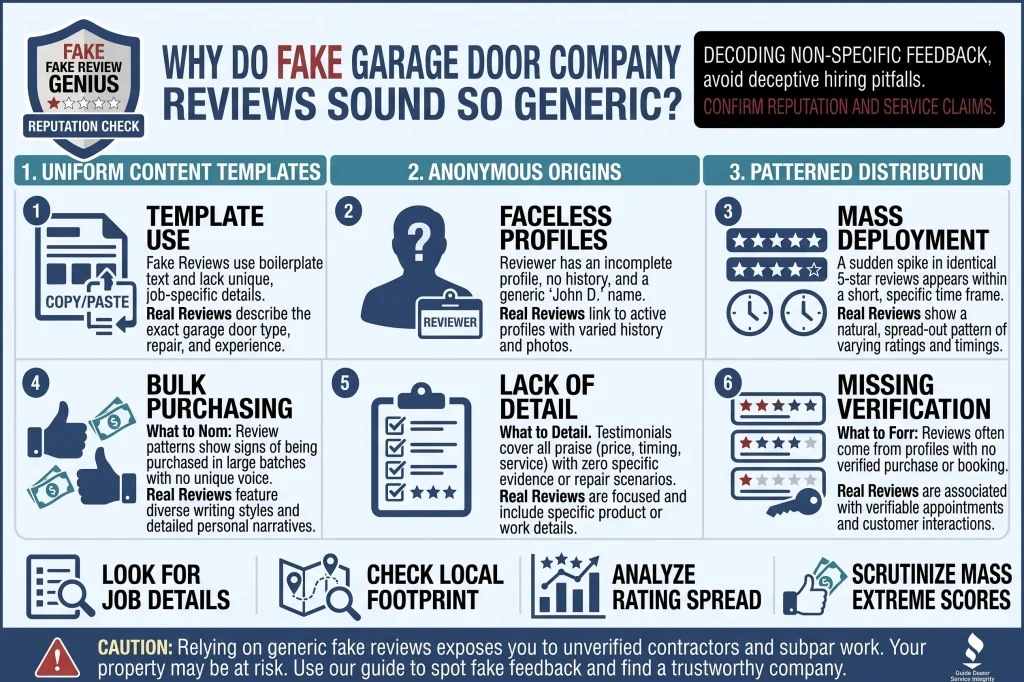
Fake garage door company reviews sound generic because the reviewer never actually used the garage door repair service, so the review has to stay vague enough to apply to any company. The six phrases that most often signal a fake or low-effort review are: “great service, highly recommend,” “very professional team,” “fixed it quickly,” “would definitely use again,” “best in town,” and “called them and they came right away.”
Key Takeaways
- Genuine reviews almost always include a specific detail: a broken spring, an opener brand, a price range, or a technician’s name.
- Generic praise isn’t proof of a fake review on its own, but several generic reviews in a row with no specifics is a pattern worth checking.
- Real customers often mention something slightly imperfect, like a delay or a follow-up call, since real service rarely goes perfectly.
- Comparing a review’s language against the company’s own marketing copy can reveal scripted or copied phrasing.
- The fastest gut-check is asking: “Could this review have been written about literally any garage door company?” If yes, treat it with caution.
Generic Filler vs. a Real, Detailed Review
Generic Phrase | What’s Missing | What a Real Review Adds |
“Great service, highly recommend” | Any detail about the job | The part, brand, or issue fixed |
“Very professional team” | A named technician or interaction | A technician’s name or specific behavior |
“Fixed it quickly” | A timeframe or the actual repair | “Fixed the spring in under an hour” |
“Would definitely use again” | A reason tied to the first visit | An explanation linked to a specific outcome |
“Best in town” | A comparison point | A named prior bad experience with detail |
“Called them and they came right away” | Day, time, or urgency context | Same-day, weekend, or emergency specifics |
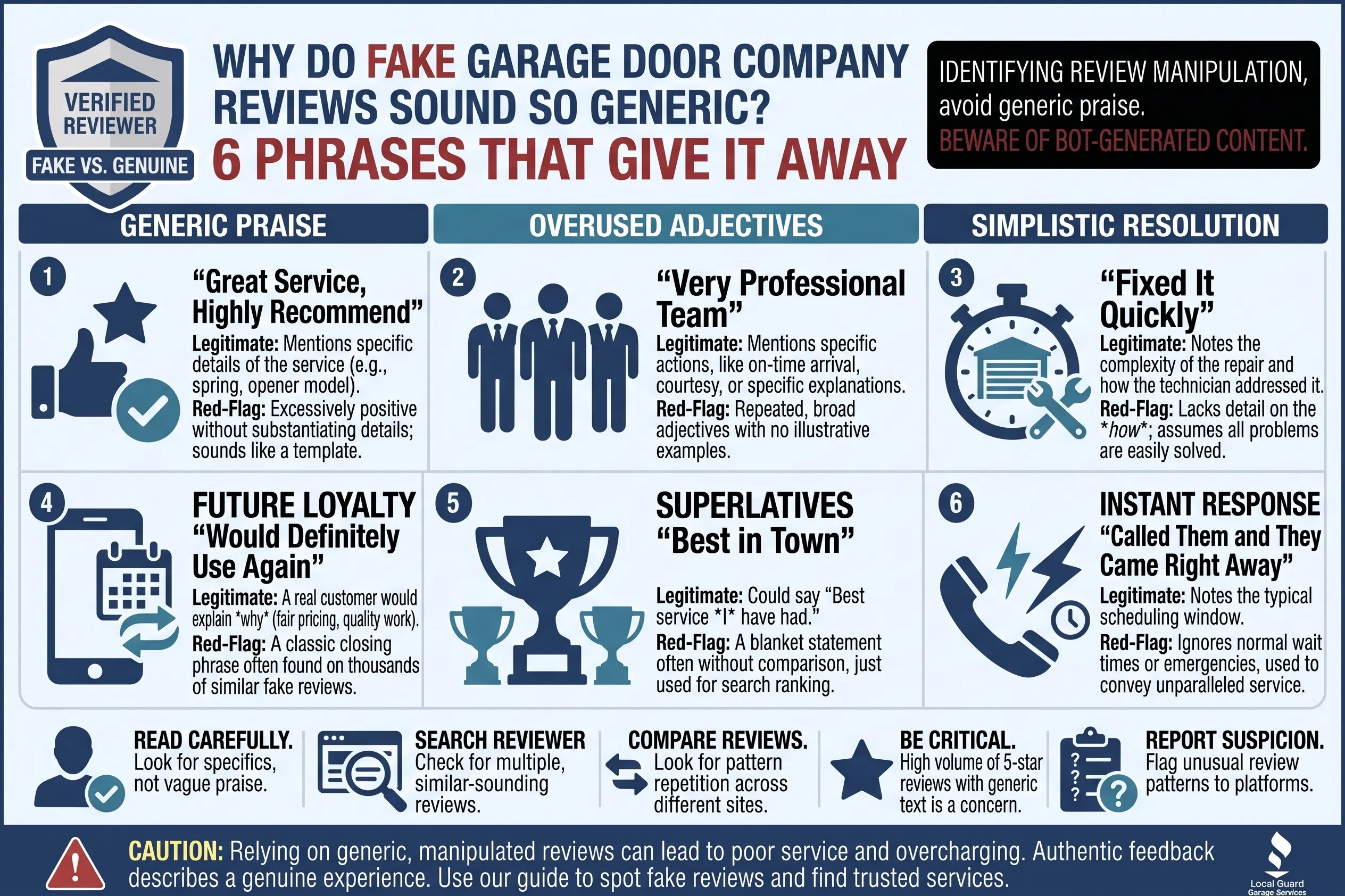
1. “Great Service, Highly Recommend”
What it looks like: A short, upbeat review with no mention of what was actually done.
Why it happens: This is the single most common filler phrase because it sounds positive while requiring zero knowledge of the actual job.
How to check it: Look at how many reviews on the page use this exact phrase or a close variation. A handful is normal; dozens repeated verbatim is not.
Trust it if: it’s paired with at least one specific detail elsewhere in the same review, even something small like a day of the week or a part name.
How to Fix a Review Set Full of “Highly Recommend” With No Detail
Don’t rely on the review text alone.
- Ask the company for two or three references you can call directly
- Request before-and-after photos of a job similar to yours
A closer look: A page with forty reviews that all read some version of “great service, highly recommend” and nothing else starts to feel less like forty different customers and more like one voice repeated forty times. Real customers, even happy ones, tend to describe at least one small detail that makes their experience their own.
If you want the full checklist for evaluating a review page beyond just wording, read How to Tell If the Garage Door Company Reviews Are Fake.
2. “Very Professional Team”
What it looks like: Praise for the company’s professionalism in general terms, with no technician name or specific interaction described.
Why it happens: “Professional” is a safe, positive word that doesn’t require the reviewer to have any real knowledge of how the job went.
How to check it: See if any reviews name an actual technician. A company that consistently gets reviews naming specific staff members by name is showing a stronger trust signal than one that never does.
Trust it if: the review also mentions how the technician handled a specific issue, not just a general impression.
A closer look: “The technician was professional” tells you almost nothing. “The technician, Mike, walked me through why the spring broke and showed me the worn part before replacing it” tells you a lot, and it’s the kind of detail that’s hard to invent if it didn’t happen. Reviews naming an actual staff member by name are worth more weight than ones praising “the team” in the abstract.
3. “Fixed It Quickly”
What it looks like: A vague claim about speed with no timeframe, no mention of what was actually broken, and no detail about the repair itself.
Why it happens: Speed is an easy thing to praise generically because it requires no technical knowledge of garage doors.
How to check it: Compare against reviews that give an actual timeframe (“fixed the spring in under an hour”) versus ones that just say “quickly” with nothing else.
Trust it if: a rough but specific timeframe or the actual problem is named alongside the praise.
Why Do Fake Reviews Avoid Naming the Actual Repair?
Because naming a specific repair, like a broken torsion spring or a misaligned sensor, requires the reviewer to have actually experienced that repair. Reviewers writing without real firsthand knowledge default to vague praise instead.
The International Door Association’s Scam Awareness resources for homeowners note similar patterns of vague, unverifiable claims across the garage door industry, and the association’s LinkedIn post on garage door industry scam awareness flags the same vague-language pattern industry-wide.
A closer look: “Fixed our garage door quickly” could describe literally any repair on any door for any homeowner. “Replaced our snapped torsion spring in about 40 minutes on a Saturday” could only have been written by someone who was actually there. The second version costs the reviewer nothing extra to write if it’s true, which is exactly why its absence is worth noticing.
If the reviews also seem to have appeared in a sudden wave rather than just sounding vague, read Why Do Garage Door Companies Get Sudden Bursts of 5-Star Reviews? 4 Red Flags to Watch.
4. “Would Definitely Use Again”
What it looks like: A forward-looking statement of intent to rehire, without describing the first experience at all.
Why it happens: It’s an easy, low-effort way to signal satisfaction without providing any information that could be checked.
How to check it: Ask whether the review explains why the reviewer would use the company again. Real reviews usually tie this statement back to a specific positive experience.
Trust it if: it’s the closing line of an otherwise detailed review, not the entire review.
A closer look: “Would definitely use again” on its own is a throwaway line. “Would definitely use again, since they were upfront about the price before starting and didn’t try to upsell us on a new opener we didn’t need” is a real endorsement backed by a specific reason. The phrase itself isn’t the problem; a review built entirely around it with nothing else attached is.
5. “Best in Town”
What it looks like: A superlative claim with no comparison point, no mention of any other company, and no explanation of why.
Why it happens: Superlatives are common in incentivized or scripted reviews because they sound enthusiastic without requiring specifics.
How to check it: Look for reviews that actually compare the company to a prior bad experience with another company, which is a stronger and more credible form of the same claim.
Trust it if: the comparison includes real detail, such as a specific issue the previous company failed to fix.
A closer look: “Best garage door company in Wake Forest” with nothing else attached is marketing language dressed up as a review. “Way better than the last company we used, who quoted us for a full opener replacement when it turned out to just be a $40 sensor issue” is a comparison with a real story behind it. The superlative isn’t the red flag by itself; the absence of any reason behind it is.
If you suspect the reviews were bought outright rather than just vague, read Are Garage Door Companies Paying for Reviews? 5 Signs of Incentivized Ratings.
6. “Called Them and They Came Right Away”
What it looks like: Praise for response speed with no day, time, or context, such as whether it was an emergency call or a scheduled appointment.
Why it happens: Response time is easy to praise vaguely without any real experience of scheduling or waiting for a technician.
How to check it: Check whether the review specifies same-day, next-day, or a rough wait time, versus just “right away” with nothing else.
Trust it if: it includes a specific circumstance, like a weekend emergency call or a same-day appointment for a stuck door.
A closer look: “They came right away” doesn’t tell you much. “Called on a Sunday morning with the door stuck open and they had someone out by 1 pm” tells you exactly what “right away” meant in practice, which is far more useful when you’re trying to judge how a company actually handles urgent calls.
Generic-Language Red Flag Checklist
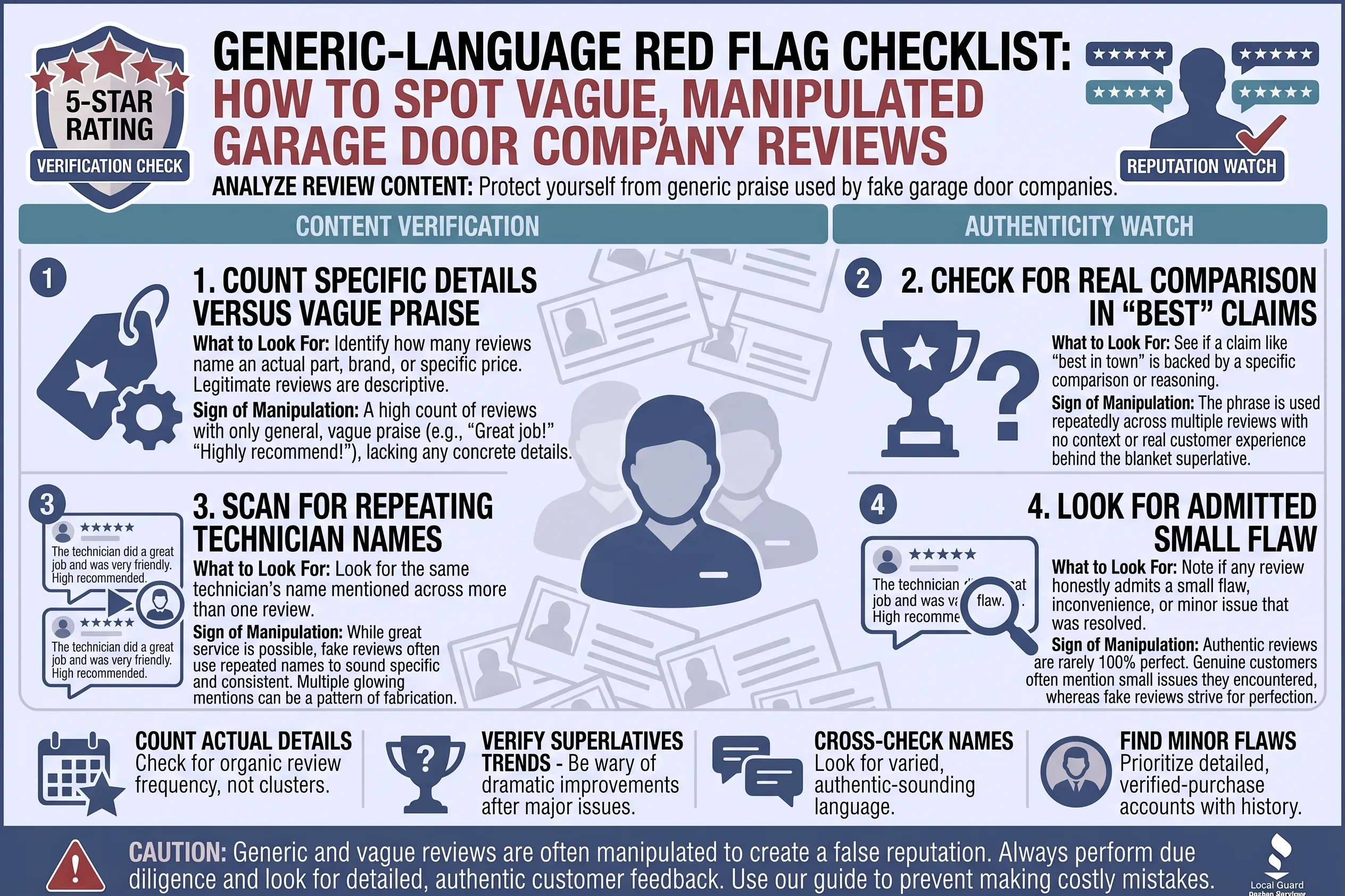
- Count how many reviews name an actual part, brand, or price versus vague praise alone
- Check whether a claim like “best in town” comes with any real comparison behind it
- Look for the same technician’s name showing up across more than one review
- Note whether any review admits a small flaw, since fake reviews rarely include one
Read Between the Lines
A single generic review doesn’t prove anything, but a review page dominated by these six phrases, with no part names, prices, technician names, or timeframes anywhere, is a real signal to slow down. The good news is that this check doesn’t take long: reading through 8 to 10 reviews and counting how many include a genuine, checkable detail usually tells you what you need to know.
DoorJam Garage hears this concern often from homeowners who notice a review page full of generic praise with nothing to back it up. If you want reviews with real detail, contact us today or give us a call.