
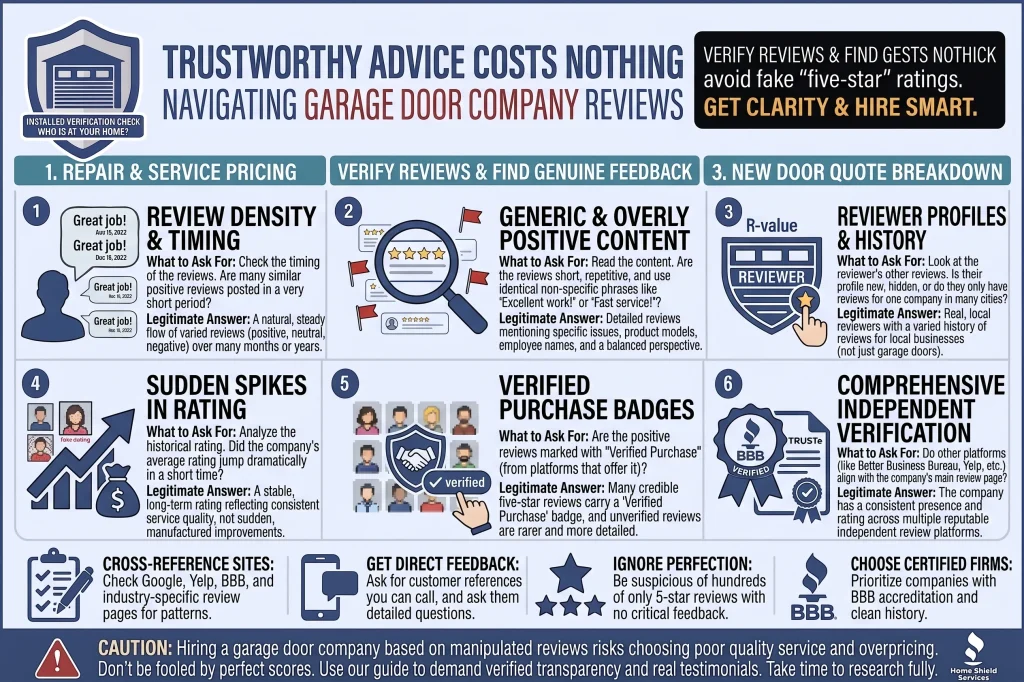
The fastest way to spot fake garage door company reviews is to check for four things: a sudden spike of five-star reviews, generic language with no job-specific details, an unnatural ratio of perfect scores with almost no negative reviews, and reviewer profiles that look brand new or single-use. If a company’s review page for garage door repair shows two or more of these patterns, treat the rating with caution and verify the business another way before booking.
Key Takeaways
- A burst of 10+ five-star reviews in a few days almost always signals a review-buying campaign, not happy customers.
- Genuine reviews mention specifics: the part that broke, the technician’s name, the price range, how long the job took. Fake reviews stay vague.
- No negative or 3-star reviews at all, especially on a company with hundreds of reviews, is itself a red flag.
- Reviewer profiles with no photo, no other reviews, or a history limited to one industry are common markers of paid review farms.
- Cross-check the same business across Google, Yelp, and Facebook. Wildly different ratings between platforms often mean reviews were bought on the higher-scoring platform.
- A licensed, insured company with a real local address rarely needs to fake its reviews.
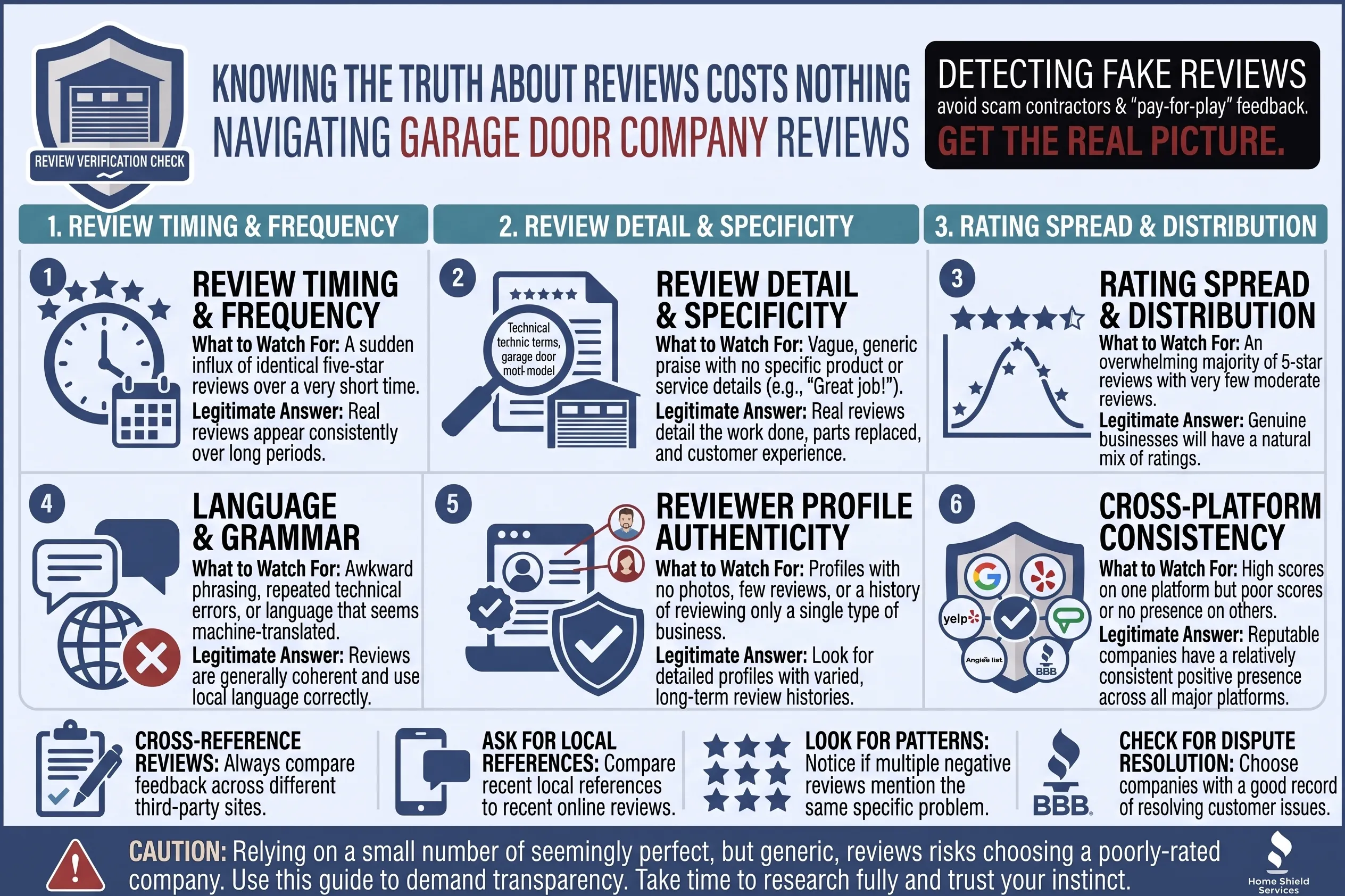
Genuine Reviews vs. Fake Reviews: Quick Comparison
Signal | Genuine Review Pattern | Fake Review Pattern |
Timing | Steady trickle over months or years | Sudden burst of many reviews in days |
Detail | Names a part, price range, or technician | Generic praise, no specifics |
Rating spread | Mostly positive, some 3-4 star reviews mixed in | Nearly all 5-star, almost no criticism |
Language | Varied wording, some awkward phrasing | Repeated or near-identical phrasing across reviews |
Reviewer profile | Reviews multiple, varied local businesses | New account, single review, no photo |
Cross-platform | Ratings roughly consistent across Google, Yelp, Facebook | One platform wildly higher than the others |
1. The Reviews Sound Generic and Repetitive
What it looks like: Dozens of five-star reviews that all read like a template: “Great service, very professional, highly recommend!” with no mention of what was actually repaired, replaced, or installed.
Why it happens: Paid review services and review-farming schemes give reviewers a rough script instead of asking for their actual experience, so the result sounds positive but says nothing verifiable.
How to check it: Read five or six reviews back to back. A real garage door review usually names something concrete: a broken spring, a noisy opener, a brand, a price, or a technician’s first name. If none of the recent reviews mention that, be skeptical.
Trust it if: the reviews include small, specific, sometimes unflattering details, like a delay in scheduling or a follow-up visit. Genuine feedback is rarely uniformly polished.
How to Check If a Garage Door Company’s Reviews Are Generic Filler
Pull up the 10 most recent reviews and count how many mention a specific part, brand, price, or technician name. If fewer than half do, the review set is likely padded with filler content rather than real customer feedback.
For the exact phrases to watch for, see Why Do Fake Garage Door Company Reviews Sound So Generic? 6 Phrases That Give It Away.
2. A Company Gets a Sudden Burst of Five-Star Reviews
What it looks like: A business jumps from 20 reviews to 80 in a week or two, almost all five stars, often after a period of little to no review activity.
Why it happens: Review-buying services deliver reviews in batches, and struggling or newly rebranded companies sometimes purchase a wave to bury a bad reputation or fake early traction.
How to check it: On Google, open the reviews, sort by “Newest,” and scroll through the dates. A steady trickle over months looks organic; a wall of same-week reviews does not.
Trust it if: the burst lines up with a real event, like a grand opening or a company-wide push after a large job that plausibly generated many real customers at once.
For a deeper breakdown of this specific pattern, see Why Do Garage Door Companies Get Sudden Bursts of 5-Star Reviews? 4 Red Flags to Watch.
Why Do Garage Door Companies Get Sudden Bursts of Five-Star Reviews
The most common reason is a paid review campaign timed to offset recent bad press or inflate a low review count quickly. Legitimate review growth is gradual and tied to job volume.
3. Reviewers Seem to Be Paid or Incentivized
What it looks like: Reviews that read like advertising copy, sometimes repeating the company’s own marketing phrases almost word for word, or reviewers who mention receiving a discount, gift card, or “thank you” for leaving a review.
Why it happens: Some companies offer incentives (a free service call, a gift card, a discount) in exchange for a five-star review, which most major platforms prohibit because it skews the rating.
How to check it: Search the exact phrasing from a review. If several reviews across the same business use identical or near-identical wording, that’s a sign of a script rather than independent customers.
Trust it if: the reviewer discloses a discount for an honest review and still describes real specifics about the job. Disclosed incentives paired with detailed, mixed feedback are far less concerning than undisclosed ones.
For the full list of signs, see Are Garage Door Companies Paying for Reviews? 5 Signs of Incentivized Ratings.
Are Garage Door Companies Paying for Reviews? Signs of Incentivized Ratings
Look for these signs together:
- Repeated phrasing across reviewers
- Mentions of a discount tied to the review
- A pattern of five-star-only feedback with zero criticism
Two or more together is a strong signal.
4. There Are No Verifiable Details About the Job
What it looks like: Reviews that praise “the team” or “the company” broadly without naming a technician, describing the actual repair, or mentioning how they found the business.
Why it happens: Fake reviewers have never actually used the service, so they can’t describe specifics. They write around the gap with generic praise.
How to check it: Compare a handful of reviews against the company’s actual service offerings on its website. If reviews never mention any of the specific services (spring repair, opener installation, sensor issues) the company advertises, that’s a mismatch worth noting.
Trust it if: the review names a specific service, a rough cost, or a timeframe (“fixed my spring in under an hour”). Specificity is hard to fake.
How to Fix a Hiring Decision Based on Vague Reviews
Don’t rely on star rating alone.
- Ask the company directly for two or three recent local references
- Request photos of a completed job similar to yours
5. Negative or Mixed Reviews Are Missing Entirely
What it looks like: A business with hundreds of reviews and a near-perfect 4.9 to 5.0 average, with no 1, 2, or 3-star reviews visible at all.
Why it happens: Some companies filter negative reviews by asking happy customers to review publicly while diverting unhappy customers to a private feedback form. Others may have the whole profile built on purchased reviews that skip criticism altogether.
How to check it: Filter reviews by star rating. If a company with 200+ reviews shows zero results below 4 stars, that’s statistically unusual for a real service business over multiple years.
Trust it if: there are a small number of critical reviews and the business responded professionally to each one. A handful of mixed reviews with thoughtful owner responses is a stronger trust signal than a spotless page.
Why a Perfect 5-Star Rating Can Be a Warning Sign
A completely flawless rating across hundreds of reviews is statistically rare. Real home-service businesses deal with scheduling conflicts and the occasional unhappy customer, and that shows up somewhere in an honest review history.
6. Reviewer Profiles Look New, Empty, or Single-Purpose
What it looks like: Reviewer accounts with no profile photo, no other reviews, or an account created the same month it posted a glowing review.
Why it happens: Review-farming services create batches of throwaway accounts to post paid reviews, then abandon them.
How to check it: Click on a handful of reviewer names or profile icons. A reviewer who has left reviews for restaurants and other local businesses reads as a real local resident. A reviewer whose only review, ever, is a five-star post for one garage door company is a red flag.
Trust it if: most reviewer profiles have a normal, varied review history typical of an everyday customer.
This pattern isn’t unique to garage door companies. The International Door Association’s Scam Awareness resources for homeowners cover similar manipulation tactics across the broader industry, and the association’s LinkedIn post on garage door industry scam awareness highlights the same warning signs homeowners run into when comparing local contractors.
How to Check If a Reviewer Profile Is Fake
Click into three or four reviewer profiles at random. If most have only ever reviewed one business, the review set likely includes purchased or fabricated feedback.
Final Verification Checklist Before You Book
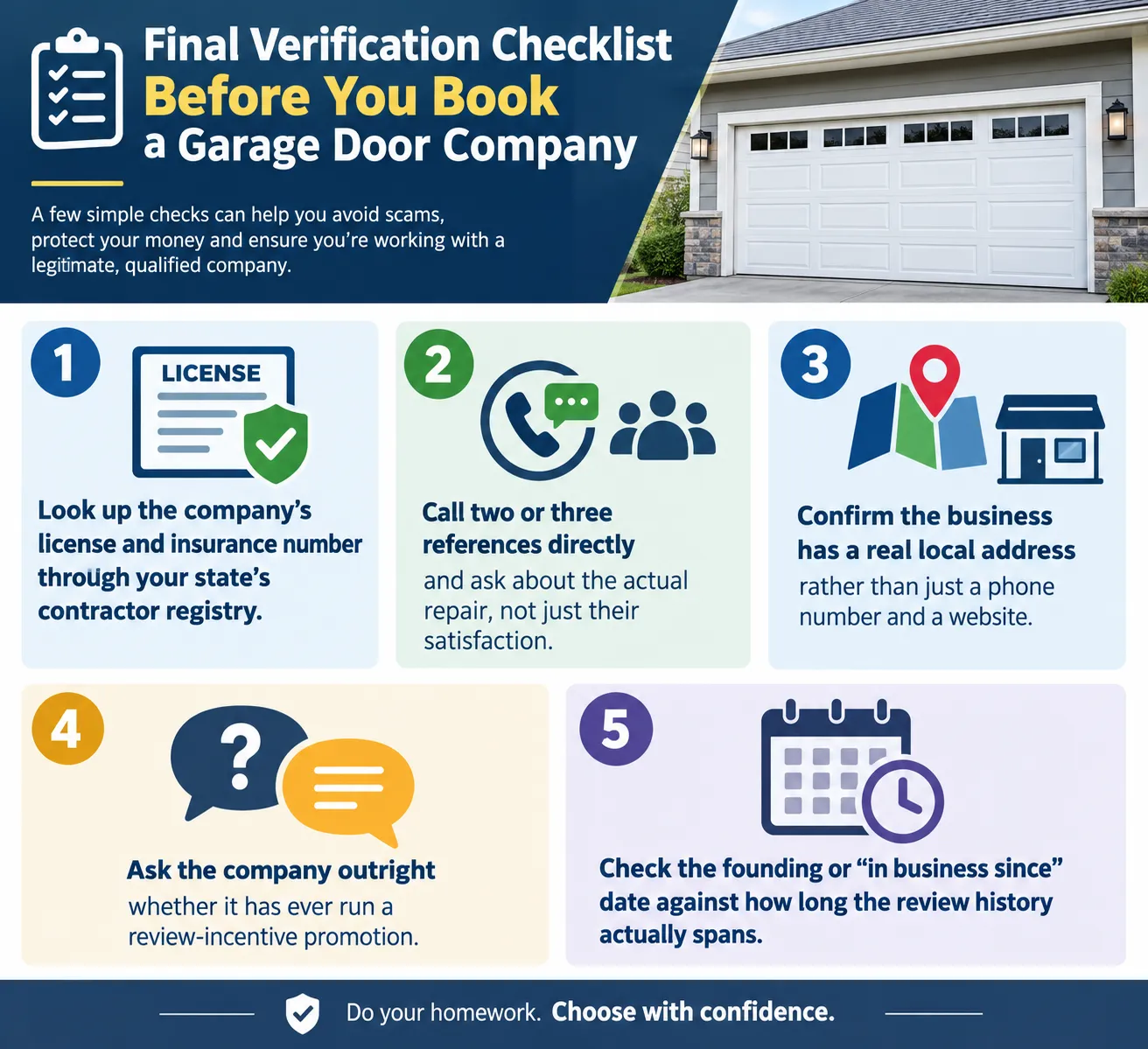
- Look up the company’s license and insurance number through your state’s contractor registry
- Call two or three references directly and ask about the actual repair, not just their satisfaction
- Confirm the business has a real local address rather than just a phone number and a website
- Ask the company outright whether it has ever run a review-incentive promotion
- Check the founding or “in business since” date against how long the review history actually spans
Trust Your Gut, Then Verify It
Star ratings are a starting point, not proof. The most reliable way to vet a garage door company is to combine review analysis with direct verification.
DoorJam Garage runs into this exact question whenever a Wake Forest homeowner asks us to weigh in on a competitor’s review page before hiring. Confirm the business is licensed and insured, ask for local references, and check for consistent ratings across multiple platforms before you commit to anything. If you’re comparing garage door companies in Wake Forest, NC, contact us today or give us a call.