
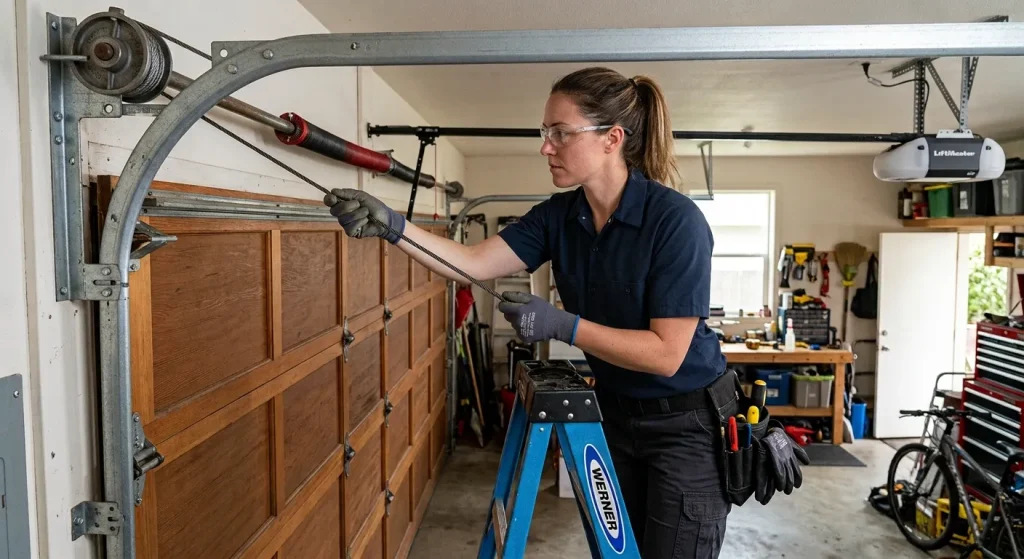
Garage door cables should be visually inspected every 6 months, and always as part of an annual professional tune-up. Unlike hinges or rollers, cables are inspect-only for homeowners: they’re under constant spring tension, and adjusting or replacing one without training can cause serious injury and turn a simple fix into a bigger garage door repair. The good news is that cable wear is usually visible before it becomes a failure, if you know where to look.
Key Takeaways
- Inspect every 6 months, minimum, and include cables in any professional tune-up.
- Homeowners should look, not touch. Cables are under tension and should only be adjusted or replaced by a trained technician.
- The clearest warning sign is an uneven door, not noise. Cables rarely squeal the way rollers do.
- Rust and fraying near the bottom bracket are the two most common early failure points.
- A snapped cable is a same-day repair, not an emergency replacement of the whole door.
Cable Inspection Points at a Glance
Location on Door | What to Look For | Risk if Ignored | Who Handles It |
Bottom bracket | Fraying, rust, thinning strands | Cable failure, door drops unevenly | Professional replacement |
Top drum | Cable slipping off track, rust buildup | Uneven wind, faster wear | Professional replacement |
Both cables (double doors) | Matching wear on each side | Sign of an alignment issue, not just cable wear | Full inspection needed |
Overall door position | Crooked or tilted when closed | Often the first visible sign of cable wear | Homeowner can spot it, pro repairs it |
Cable tension | Any looseness or slack | Injury risk if handled, signals slipping | Professional only, never DIY |
How Often Should Garage Door Cables Be Inspected Overall?
Every 6 months is the standard interval, timed to line up with your seasonal visual check of the whole door.
Cables don’t wear on a strict clock the way lubrication does. Instead, wear tracks with how many times the door cycles and how much tension the springs are holding. A high-cycle door (multiple vehicles, frequent use) can show cable wear faster than the 6-month mark, which is why the annual professional visit exists as a backstop even for households that skip the seasonal DIY look.
If you haven’t set one up yet, read How Often Should Garage Doors Be Serviced? A Season-by-Season Maintenance Checklist.
How to Inspect Garage Door Cables Safely, Without Touching Them
Stand to the side of the door, not directly in front of it, and look at two spots: where the cable wraps around the bottom bracket near the floor, and where it winds onto the drum near the top of the door. You’re checking for fraying strands, rust discoloration, or visible thinning. This is a look-only inspection. Never pull on, adjust, or attempt to re-seat a cable yourself.
Call a pro if: you see any fraying, rust, or looseness at either end of the cable, or if the door appears crooked when fully closed.
What Causes Garage Door Cables to Wear Out Faster Than Expected?
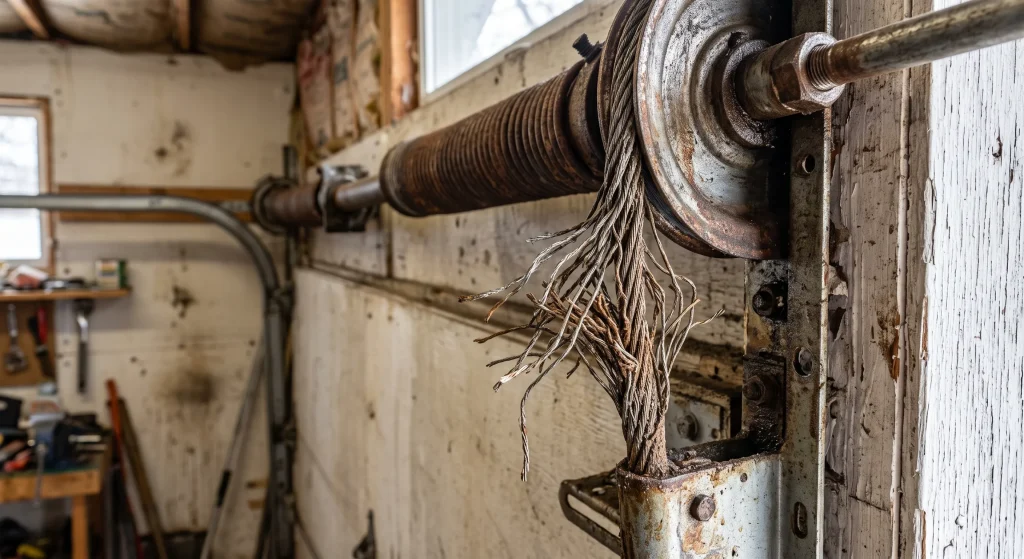
The most common causes are high cycle counts, a misaligned bottom bracket, and worn pulleys or drums that the cable runs over.
Symptom: Visible fraying at the bottom bracket, or the door sitting slightly tilted when closed.
Most likely cause: Normal wear from cycling, accelerated by a bent bracket or a drum that’s developed a rough edge.
Fix: A technician replaces the cable and inspects the bracket and drum for the underlying cause, since replacing the cable alone without fixing a bent bracket often leads to the new cable wearing the same way.
If a cable is worn enough to make the door sit unevenly, the opener may work harder to compensate, which can accelerate wear on the opener’s motor and gears too. If you’re noticing both symptoms together, read the guide on How Often Should a Garage Door Opener Be Serviced?
Springs carry a related kind of tension risk, and The Spruce’s guide to replacing garage door springs is a useful companion read on why that specific job also belongs to a professional.
How to Tell if a Cable Issue Is About to Become a Bigger Repair
If a bottom bracket looks bent, or if both cables on a double door show wear at the same spot, that’s usually a sign the door has been running slightly out of alignment for a while. Catching it during a cable inspection is a lot cheaper than waiting for it to also take out a roller or a track. Loose hinges and hardware can contribute to the same kind of uneven wear, so it’s worth checking those at the same time; read the guide on How Often Should Garage Door Hinges and Hardware Be Tightened?
Call a pro if: You notice a bent bracket, a rough spot on the drum, or matching wear on both cables of a double door.
What Happens if a Garage Door Cable Snaps?
A snapped cable is one of the more common emergency calls for garage doors, and it’s usually a same-day fix, not a sign the whole door needs replacing.
Symptom: The door won’t move, sits crooked, or one side drops lower than the other.
Most likely cause: A cable has fully separated from the bracket or drum, often after months of the fraying described above going unnoticed.
Fix: A technician replaces both cables as a pair (even if only one failed, the other is usually close behind from the same wear conditions) and re-aligns the door. A cable failure is often mistaken for a spring failure since the symptoms look similar; Angi’s guide on what to do when a garage door spring breaks covers the related tension-system risk in more detail.
How to Stay Safe if a Garage Door Cable Has Already Snapped
Don’t attempt to force the door open or closed. With a cable gone, the door is only being held by the remaining cable and the springs, and it can shift unexpectedly. Keep the area clear, don’t use the opener, and call a technician for same-day service.
Call a pro if: A cable has visibly snapped. This isn’t a DIY or wait-and-see situation.
How Long Do Garage Door Cables Typically Last?
Most garage door cables last somewhere between 7 and 10 years, though that range shifts a lot based on cycle count and climate rather than age alone.
What Determines Cable Lifespan
- Cycle count: Cables on a high-use door wear measurably faster than one that opens once or twice a day.
- Bracket and drum condition: A bent bracket or rough drum edge accelerates wear on an otherwise healthy cable.
- Climate: Humidity and temperature swings speed up rust formation at the bottom bracket.
- Spring condition: Cables and springs share the same tension system, so a spring nearing the end of its life can put uneven load on the cables too, which is exactly the kind of wear a garage door tune-up is designed to catch before it causes a failure.
Replace Proactively or Wait for Failure?
Most technicians recommend replacing cables in pairs once fraying or rust shows up, rather than waiting for one to fully separate. A cable that’s visibly worn but hasn’t failed yet is a planned, inexpensive repair. The same cable left in place until it snaps turns into an emergency garage door repair, often taking the door out of use until a technician arrives. Since cables are inexpensive relative to springs or opener repairs, there’s little upside to waiting once wear is visible.
How to Tell Cable Wear Apart From Other Garage Door Problems
A door that isn’t closing right doesn’t always mean the cables are the culprit. A few quick checks help narrow it down before calling a technician:
- Door sits crooked, but no visible fraying: More likely a spring or track alignment issue than a cable problem, though all three should be checked together since they share the same tension system.
- Rattling alongside the crooked close: Points toward loose hinges or hardware rather than cables, especially if the noise is new.
- Grinding or squealing during movement: Almost always rollers or hinges, since cables themselves don’t typically make noise as they wear.
- Door won’t open at all: Could be the garage door opener, a broken spring, or a fully snapped cable. If the door was working fine yesterday and won’t budge today, treat it as a same-day call rather than guessing at the cause.
- One side visibly lower than the other: This is the clearest cable-specific sign, especially paired with visible fraying at the bottom bracket.
Because cables, springs, and hardware all interact with the same tension and alignment system, a technician doing a cable inspection is usually checking all three at once rather than looking at cables in isolation. That’s part of why a full inspection tends to catch more than a homeowner’s visual check alone, even a careful one.
Keep Your Cables on Schedule
Cables are one of the cheaper parts on a garage door, but a missed one can take the whole door out of service overnight. Catching fraying or rust during a routine look costs nothing and takes a few minutes; catching it after a snap costs a same-day service call and a day without a working door.
DoorJam Garage includes a full cable inspection in every scheduled maintenance visit, alongside the rest of the seasonal checklist. It’s one appointment that covers cables, springs, and hardware together rather than treating each as a separate concern. Contact us today or give us a call to book a maintenance visit and get your cables checked alongside the rest of the door.