
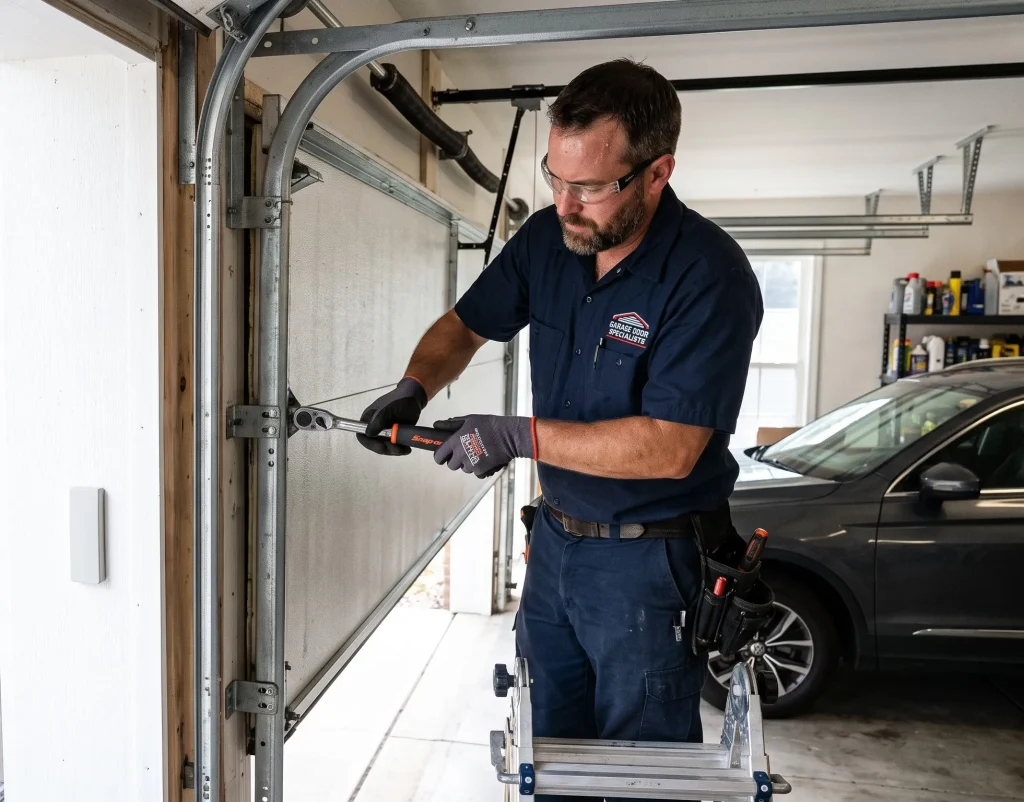
Garage door hinges, brackets, and roller hardware should be checked and tightened every 6 months, or closer to every 4 to 5 months on double garage doors, which carry more weight across the same hardware. This is one of the easiest maintenance tasks on a garage door; most of it just needs a socket wrench and a flashlight, and it’s also one of the most commonly skipped, since loose hardware rattles quietly for months before it becomes a real problem. Because the wear happens gradually and doesn’t usually stop the door from working, it’s easy to assume everything is fine right up until a bracket shifts far enough to throw the door off track and turns a simple tightening job into a full garage door repair.
Key Takeaways
- Every 6 months for single doors, every 4 to 5 months for double doors, since double doors carry more weight per hinge.
- Rattling or a slightly loose feel during opening is the earliest and most common warning sign.
- This is a DIY-safe task for most homeowners: snug, don’t overtighten.
- Cracked or bent hardware needs replacing, not tightening. Tightening a damaged part doesn’t fix it.
- Loose hardware is one of the more common root causes behind noise complaints we get called out for, alongside dry rollers.
- A door that keeps loosening the same hinge every cycle is telling you something more than “check again in six months,” and ignoring it long enough can turn a simple fix into an emergency garage door repair.
Hinge and Hardware Check Reference
Hardware Component | How Often to Check | Who Typically Handles It |
Hinges (all panels) | Every 6 months (4–5 for double doors) | Homeowner — visual and tactile check |
Roller brackets | Every 6 months | Homeowner — visual check |
Top and bottom track bolts | Every 6 months | Homeowner — tighten with socket wrench |
Bottom brackets (cable attachment points) | Every 6 months, inspect only | Professional if any movement is seen |
Center bearing plate and reinforcement strut | Annually, as part of full tune-up | Professional |
How Often Should Garage Door Hinges and Hardware Be Checked Overall?
Every 6 months is standard, timed with your seasonal look at the rest of the door in our full maintenance checklist.
Vibration from thousands of open-and-close cycles gradually loosens bolts and screws, the same way any mechanical hardware loosens over time with repeated motion. It’s rarely dramatic, which is exactly why it needs a scheduled check rather than waiting for it to announce itself. Climate plays a role too: homes that see big seasonal temperature swings put more stress on metal hardware as it expands and contracts, which can shave a month or two off the interval in practice, even if the manufacturer’s schedule doesn’t account for it.
If you haven’t set up a seasonal rhythm yet, read How Often Should Garage Doors Be Serviced? A Season-by-Season Maintenance Checklist.
How to Check Garage Door Hardware Without Taking Anything Apart
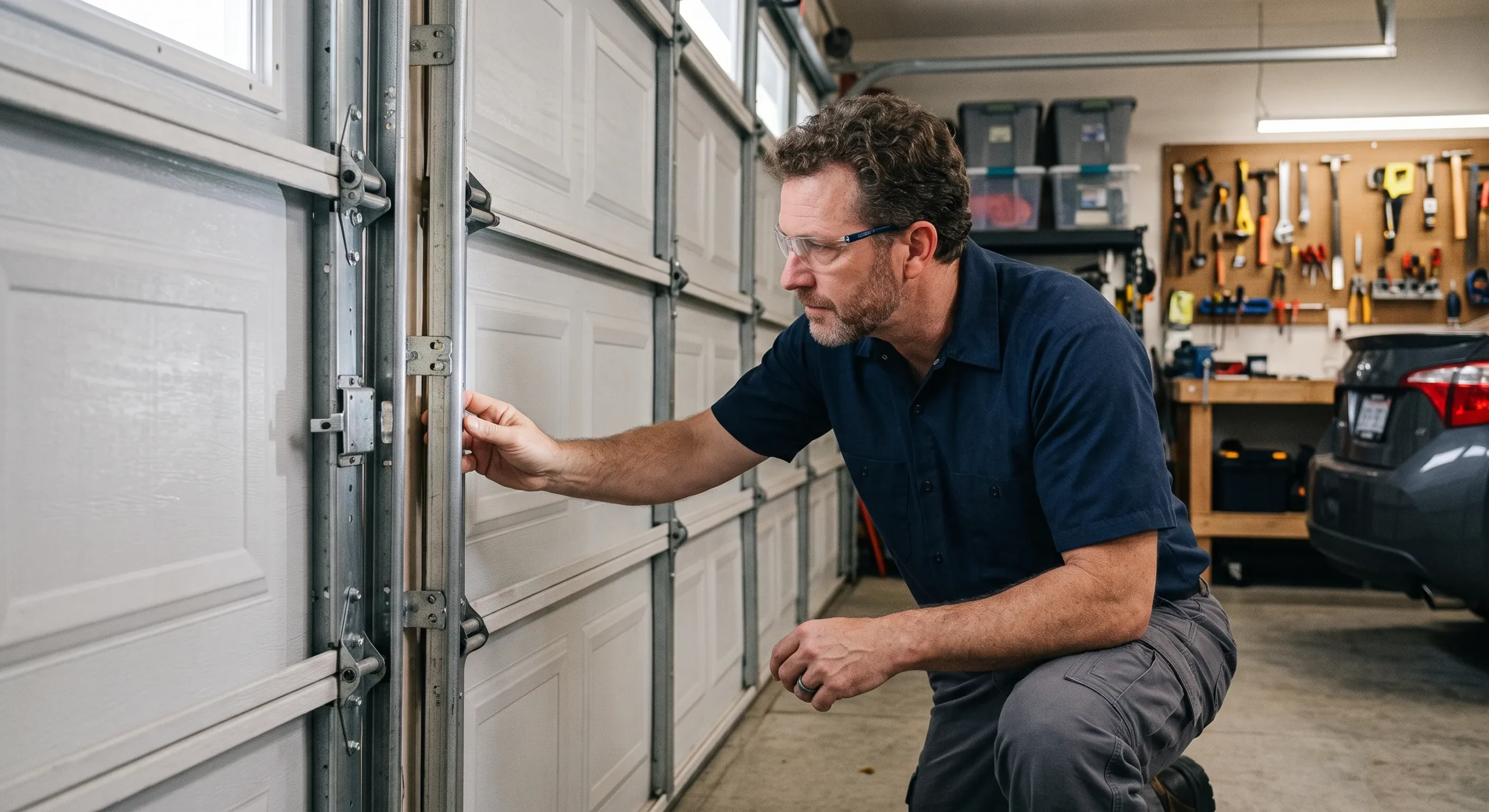
Walk the full length of the track with a flashlight while someone else runs the door slowly, open and closed. Watch each hinge point and bracket for movement that shouldn’t be there, a hinge flexing further than its neighbors, or a bracket shifting slightly as the door passes. Anything that visibly moves is due for tightening.
A more thorough version of this check takes about ten minutes and follows a simple sequence: start at the bottom bracket on one side, work your way up each hinge in order, cross to the opposite side, and finish at the top roller bracket near the garage door opener. Doing it in the same order every time makes it easier to notice if the same spot keeps coming up loose.
Call a pro if: You notice a hinge or bracket that’s cracked or bent rather than simply loose. If you’d rather vet a technician yourself before booking, the International Door Association’s care and maintenance directory is a reliable place to start.
What Causes Garage Door Hardware to Loosen Faster Than Normal?
High cycle counts, an off-track door putting uneven pressure on certain hinges, and lower-quality original hardware are the most common accelerating factors.
Symptom: Rattling concentrated at one or two specific hinge points rather than evenly across the door.
Most likely cause: Uneven wear, often because the door is running slightly out of alignment and putting more stress on those particular points.
Fix: Tightening the loose hardware solves the immediate rattle, but if it’s concentrated at the same spot repeatedly, a technician should check whether the door’s overall alignment is the root cause.
Bent or cracked hardware is treated as a safety issue rather than a maintenance one in most manufacturer guidance, since a failed hinge under load can let a section of the door drop unexpectedly; DASMA’s general safety tips cover this kind of hardware-failure risk in more detail.
A door that’s binding at a loose hinge also makes the opener work harder to pull it through that section, which can accelerate wear on the chain, belt, or motor gears; if you’re noticing rattling hardware alongside an opener that seems to strain, read our guide on How Often Should a Garage Door Opener Be Serviced?
How to Tell if Loose Hardware Is a Symptom of a Bigger Alignment Issue
If you tighten the same hinge or bracket every 6 months and it’s loose again well before the next check, that’s a sign of a deeper alignment problem rather than normal wear. Compare it to the door’s other hinges. If one spot consistently loosens faster than the rest, that’s worth a professional look rather than repeat tightening.
This pattern shows up most often on doors that have been hit or nudged at some point, whether by a car bumper, a bike, or just years of a door slightly binding on one side of the track. The hardware isn’t the problem; it’s absorbing stress that the misaligned track should be distributing more evenly.
Call a pro if: The same hardware point keeps loosening faster than a normal 6-month interval.
If the door also looks slightly crooked when closing, it’s worth checking cable wear at the same time; read our guide on How Often Should Garage Door Cables Be Inspected?
How Tight Should Garage Door Hardware Be?
Snug, not forced. Overtightening is a less common mistake than undertightening, but it happens, and it can cause its own problems.
Symptom: A hinge that doesn’t pivot smoothly, or a bracket that’s slightly bent from being overtightened.
Most likely cause: Bolts tightened well past snug, which can restrict the natural flex hinges need as the door moves.
Fix: Back the bolt off slightly until the hinge can pivot freely again, then confirm it’s not loose at that reduced tension.
There’s no single torque spec homeowners need to memorize here; garage door hardware is designed to be tightened by feel rather than to a precise number, which is part of why this task is considered DIY-safe in the first place.
How to Avoid Overtightening Garage Door Hardware
A good rule of thumb: Tighten until you feel resistance, then stop. Hinges specifically need to flex as the door curves around the track, so a hinge that’s rigid after tightening has likely been overtightened rather than properly snugged. This is exactly the kind of detail a technician double-checks during a full garage door tune-up, since a homeowner working quickly can miss the difference between snug and overtightened.
Call a pro if: You’re unsure whether a hinge is properly tightened or over-restricted, especially if the door starts moving less smoothly after a DIY tightening pass.
How Many Hinges and Brackets Does a Typical Garage Door Have?
- Most residential doors use three to four hinges per side on a standard-height door, numbered from the bottom up, plus a top roller bracket and a bottom bracket on each side where the cables attach.
- Wider or taller doors, and most double-car doors, typically add an extra hinge per side to handle the additional panel weight, which is part of why double doors are more prone to loosening faster than single doors.
- Knowing roughly how many attachment points your door has makes the flashlight walk-through faster, since you know exactly how many spots to check on each pass rather than guessing.
- Not all hinges do the same job: the ones attached directly to a roller bracket carry weight and track tension in addition to letting the panel fold, so they tend to loosen a little faster than the hinges in the middle of a panel that is only managing the fold itself.
- If you’re triaging a quick check because you’re short on time, start with the roller-adjacent hinges first.
Keep Your Hardware on Schedule
Loose hardware is one of the cheapest problems on a garage door to catch early, and one of the noisier ones to ignore. It’s a quick add-on to any visit, but skipping it is how a five-minute fix turns into a worn-out bracket or a door that suddenly needs realignment.
DoorJam Garage checks every hinge, bracket, and roller mount as part of our scheduled maintenance visits, alongside the rest of our seasonal maintenance checklist. Most homeowners are surprised how much quieter and smoother a door runs once every hinge and bolt is back to snug. If it’s been a while since anyone’s looked at your hardware, that alone is often reason enough to get on the schedule. Contact us today or give us a call to book a maintenance visit, and we’ll tighten and inspect everything in one appointment.